, Di Vincenzo, S., Weiler, M., Mitchell, T.M., Toy, V.G 2026
The Other Ductile – Brittle Transition Zone:
Syn-Deformational Lithification Within the Shallow Subduction Shear Zone and its Implications for Earthquake Nucleation
Abstract
Read abstract…
Subduction zones are uniquely direct pathways in which originally unconsolidated sediment is conveyed to great depths, all while experiencing continuous shear as it lithifies and metamorphoses. The largest earthquakes on our planet occur within these zones, along with other seismic and aseismic phenomena. The products of these processes are accreted mélanges which provide ‘windows’ into the otherwise inaccessible plate boundary interface at depth. The bulk physical behaviour of these subduction shear zones is controlled by the geometries of the blocks, the proportions of blocks to matrix, and the relative mechanical properties of blocks and matrix. Here we provide a structural and mechanical characterisation of the Chrystalls Beach Mélange, New Zealand, and trace its rheological evolution from the surface to the shallow seismogenic zone. We conducted a detailed 3D macro- and micro-structural investigation coupled with in-situ and laboratory-based rock mechanics to measure sub-block-scale heterogeneities and explain their origins.
The Chrystalls Beach Mélange formed within a Mesozoic Gondwanan–Pacific subduction zone, achieving maximum metamorphic conditions of <600 MPa/<300°C, within the shallow seismogenic zone and below the conditions required for quartz crystal-plasticity. This mélange is composed of subducted seafloor sediments that form decametre- to millimetre-sized blocks of sandstone and chert within a pelitic matrix, mixed with minor exotic blocks of altered basalt. These blocks display overprinting relationships showing a progression from ductile to brittle deformation as they transition from soft sediment to low-grade metamorphosed rock coincident with burial and pervasive shearing.
Four distinct rheological and tectonic regimes were responsible for the structural features we documented:
- Layer-parallel shortening and fluidisation in the frontal toe of the subduction zone. Unconsolidated interbedded sand, mud, and siliceous ooze experienced ductile deformation producing isoclinal folds and injectites.
- Layer-parallel extension of poorly consolidated ductile sediments resulted in boudinage and dismemberment in the shallowest subduction channel. This produced blocks with moderate – high aspect ratios, sharp tips, and asymmetric profiles.
- Continued layer-parallel extension as the blocks lithified and embrittled. Internal stresses transferred from the matrix exceeded the yield stresses of the still-weak blocks, resulting in pervasive brecciation, followed by fragmentation as fluidised matrix injected into these fractures. This produced sub-rounded – sub-angular blocks with low – moderate aspect ratios, blunt tips, and irregular profiles. As blocks continued to indurate to the point that they could no longer be broken by stresses imparted by the matrix, they may still have been broken as they jostled and temporarily jammed the shear zone. At the same time, exotic blocks of basalt entered the mélange as rigid inclusions but underwent progressive weakening during subduction as they experienced brecciation and altered to clay minerals.
- Localisation of strain previously distributed in the matrix towards more localised shear zones and veins in anastomosing networks.
In-situ Schmidt hammer strength tests show that block margins are systematically weaker than block cores across all lithologies. This is consistent with the increased fracture density towards block margins. As such, mélange blocks within the shallow seismogenic zone display significant internal heterogeneity and should not be considered as two-phase mixtures.
Introduction
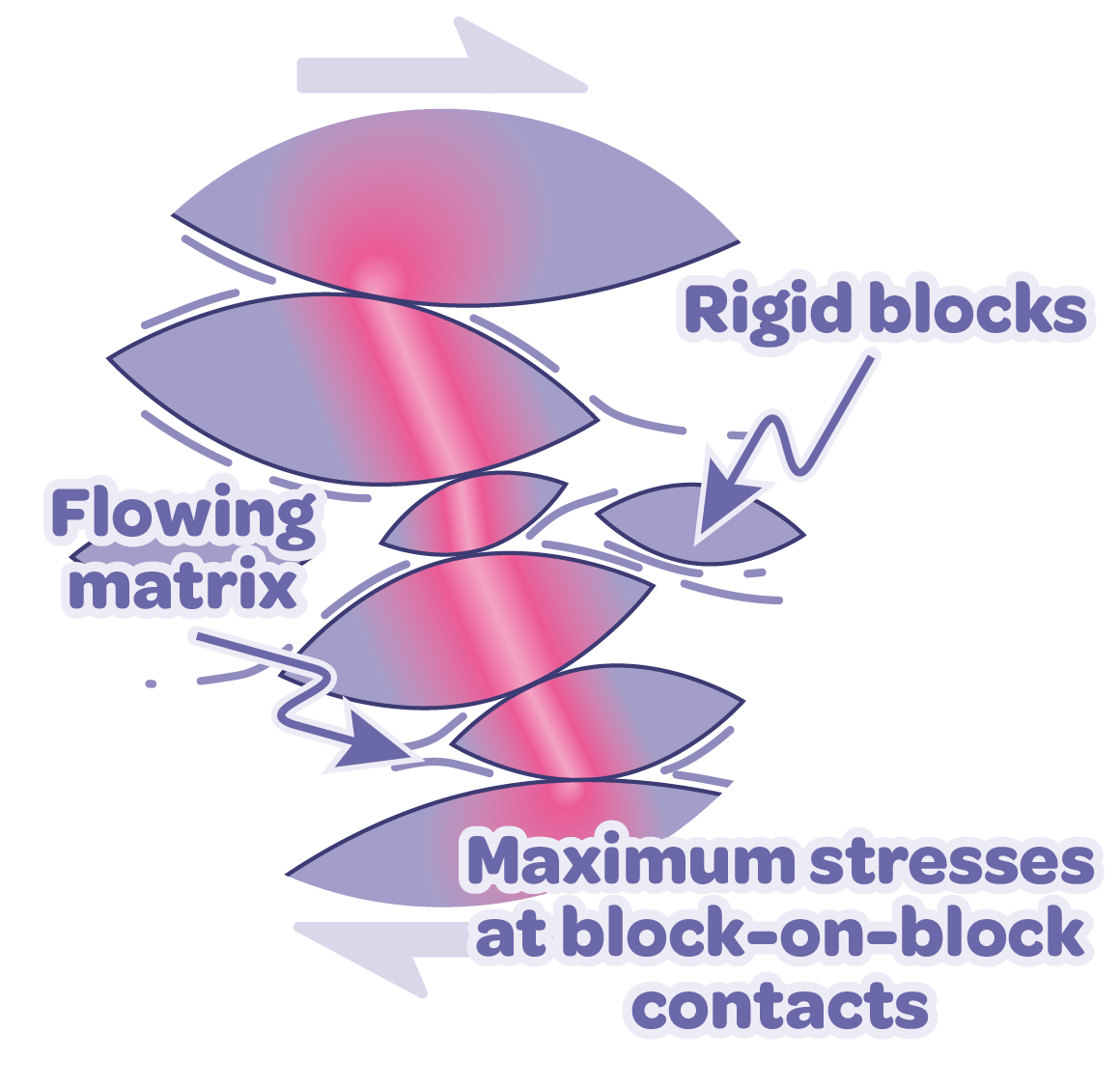
Mélange rheology is understood as a two-phase mixture of internally-homogenous, strong & competent blocks within a flowing, weak & compliant matrix1,2. It follows that earthquakes within mélanges occur when blocks jam the subduction channel & must break to allow continued shear1,2.
Recent work shows that mélange rheologies evolve through time3,4,5 & that blocks are internally heterogenous6. Our detailed 3D outcrop & microstructural characterisation of the Chrystalls Beach mélange (New Zealand) reveals that coincident lithification & shearing causes fragmentation of blocks without interactions with neighbouring blocks.
Background
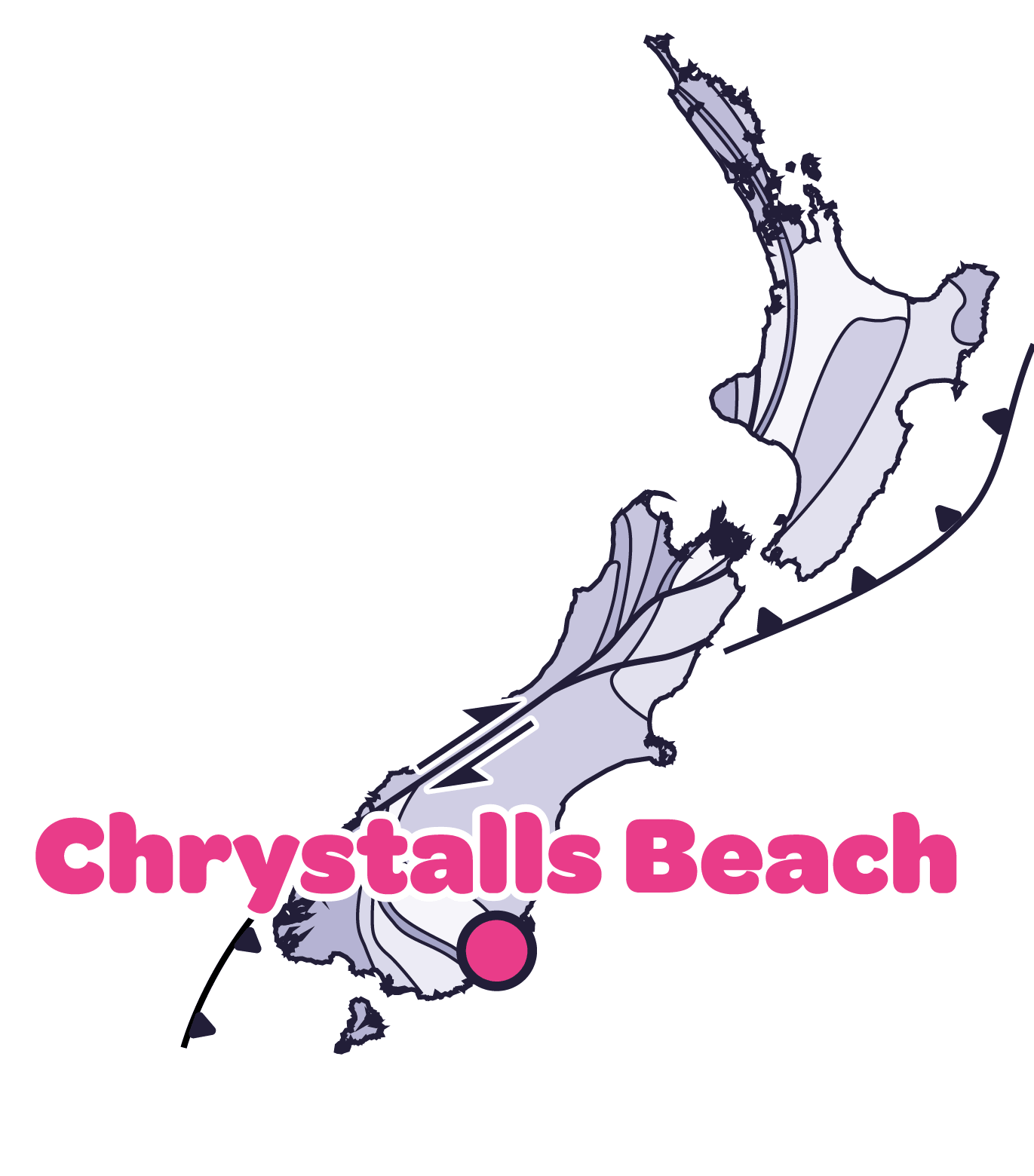
The Chrystalls Beach Complex is a terrane-bounding mélange belt within the Mesozoic Otago Schist accretionary complex formed at the paleo-subduction margin of Gondwana1,7. This unit consists of blocks of deformed sandstone, chert and rare altered basalt within a pelitic matrix. Peak metamorphism did not exceed ~300°C and ~550 MPa; therefore deformation occurred before the onset of quartz crystal-plasticity1.
Interpreted photogrammetric model of Chystalls Beach, New Zealand
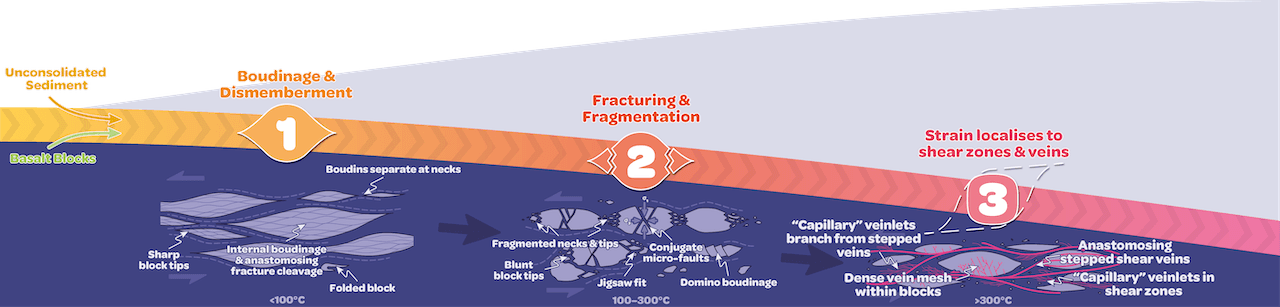
1. Soft-Sediment Deformation
Initial deformation occured during subduction of unconsolidated interbedded sediment7, creating ubiquitous ductile (e.g., folding & boudinage) & fluidisation (e.g., injectites) structures.
Folding reveals initial shortening at the frontal toe
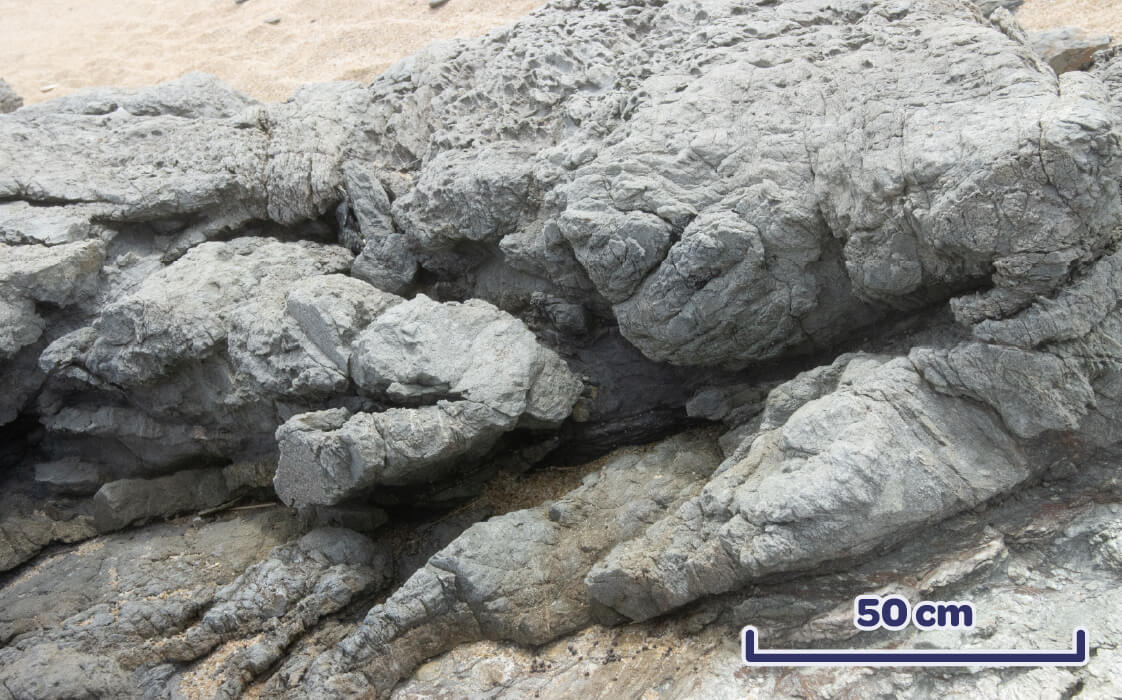


Some blocks are isoclinally folded but dominant structural style is long-axis extension.
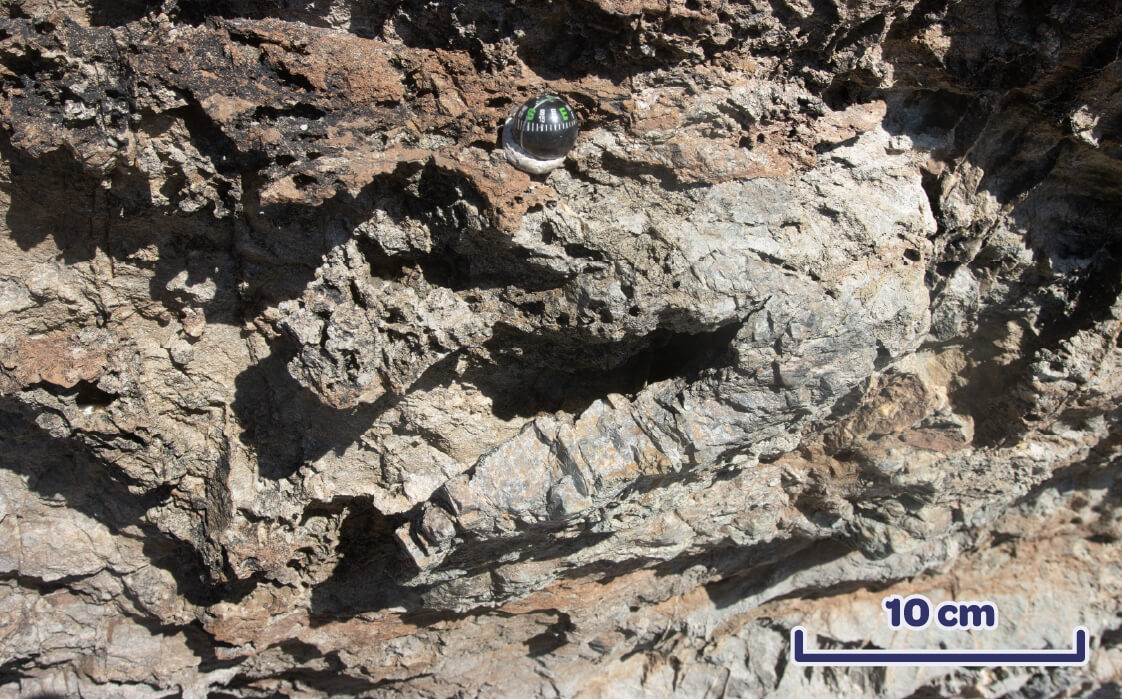

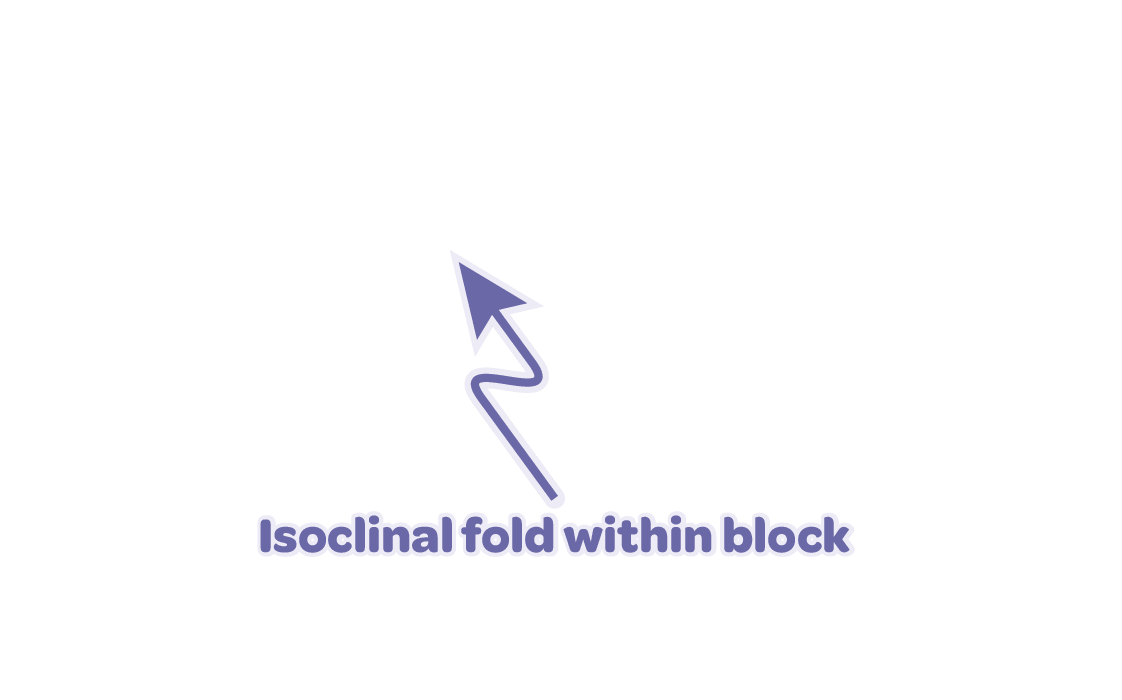
Block with an internal isolated isoclinal fold hinge indicating folding and stratal disruption occured within the lithologies that would become blocks, possibly predating mélange formation.
Pervasive boudinage indicates early ductile rheology
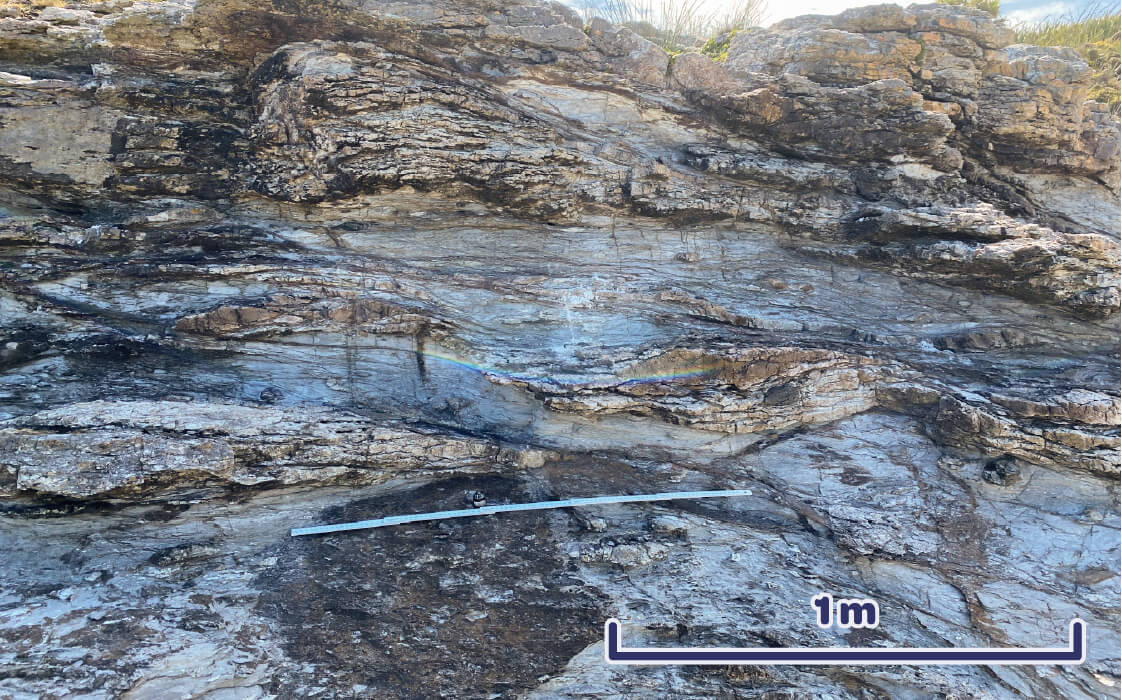
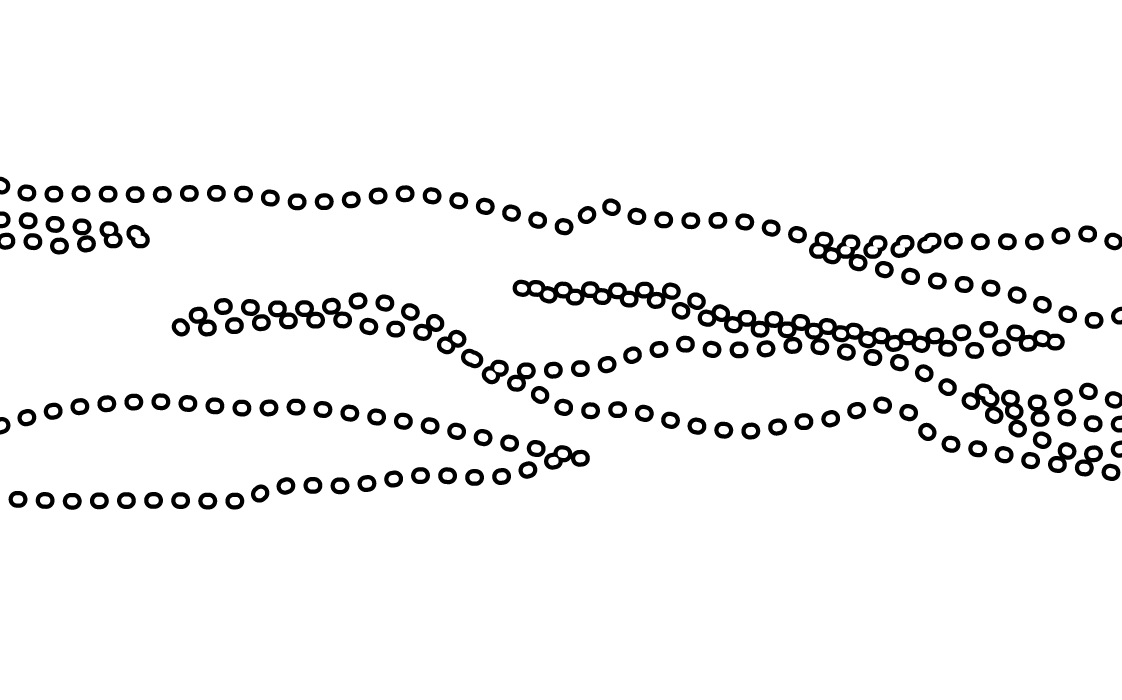
Chains of blocks with pinch-&-swell structures.
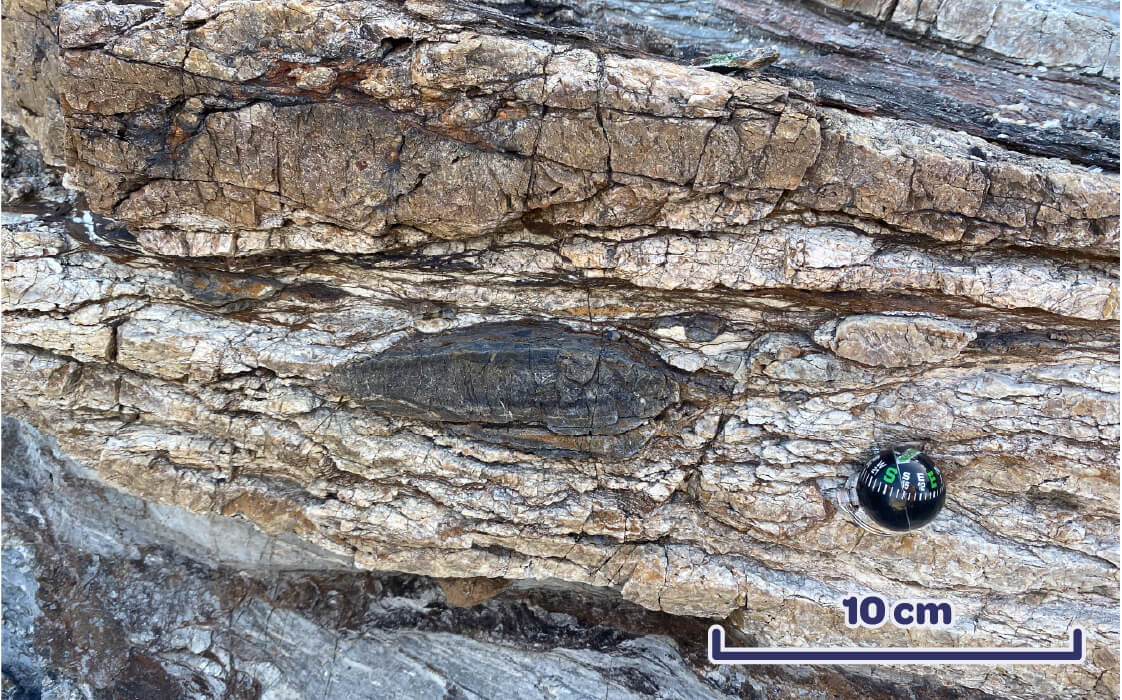
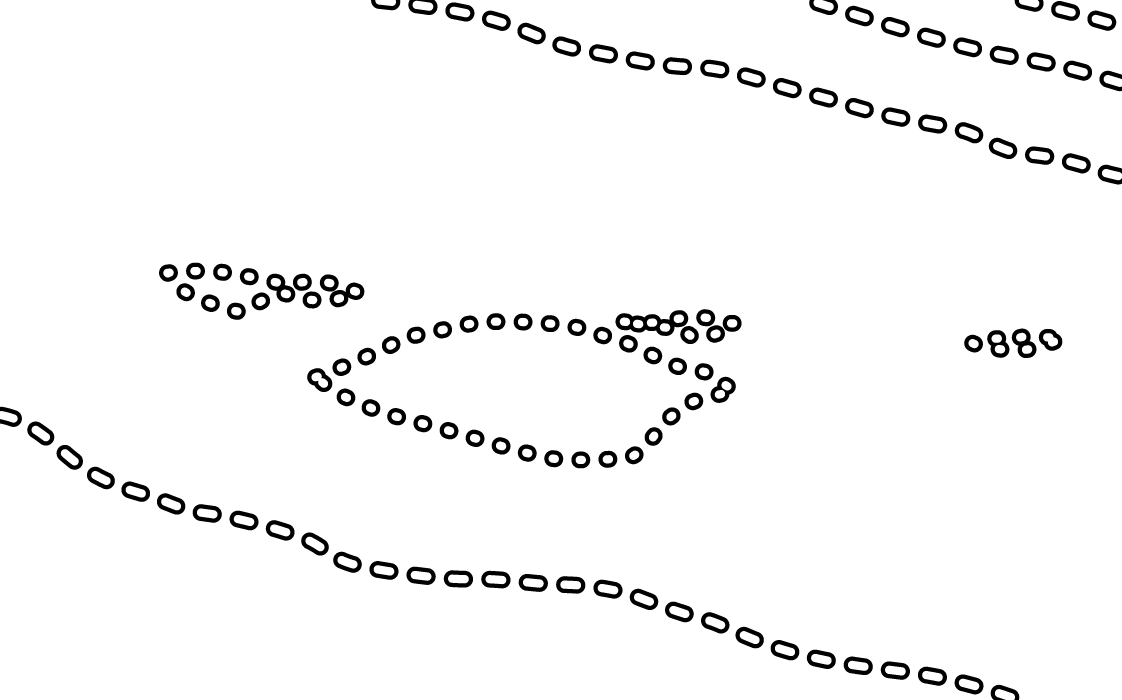
Internal boudin of black chert within block of white chert featuring internal boudinage & anastomosing fracture cleavage. As this mélange was never subducted to depths of quartz crystal-plasticity, this ductile deformation must have occured prior to lithification.
Ubiquitous mudstone injectites indicate fluidised sediment
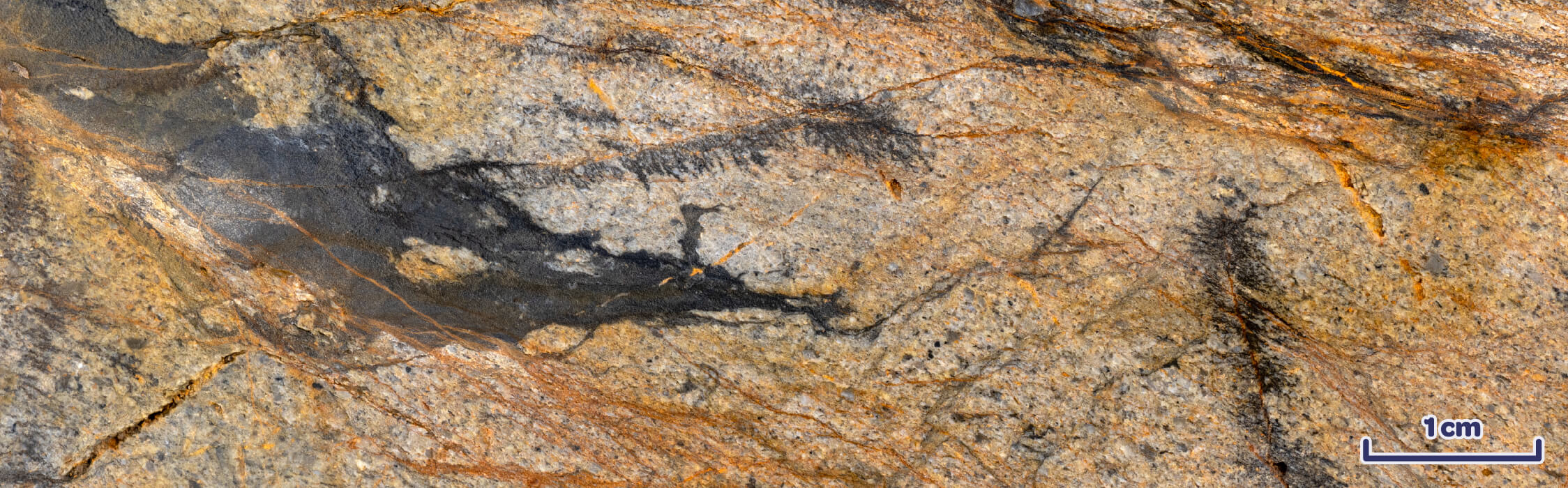


Injectite of mudstone deep within the core of a sandstone block indicates both that the mud was fluidised and that sand was weakly cohesive & able to both fracture and flow.
2. Embrittlement & Fragmentation
As the mélange lithifies, embrittled blocks experience fragmentation by fracturing & brecciation consistent with long-axis–parallel extension — the same stress regime which caused boudinage when the blocks were ductile. Brecciation is strongest at block tips & margins, producing weak margins & strong cores.
Blocks fragment at the ductile–brittle transition
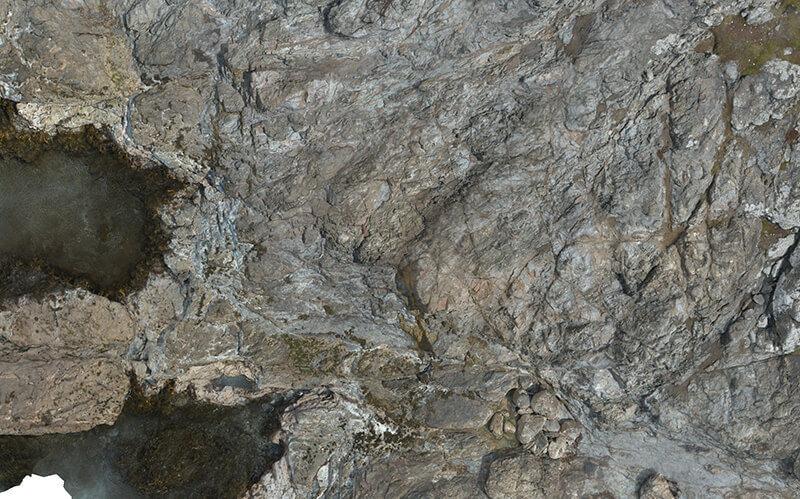
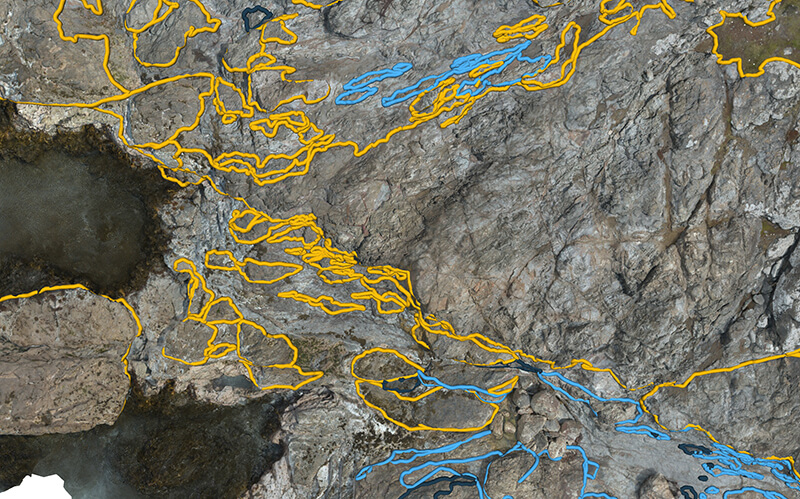
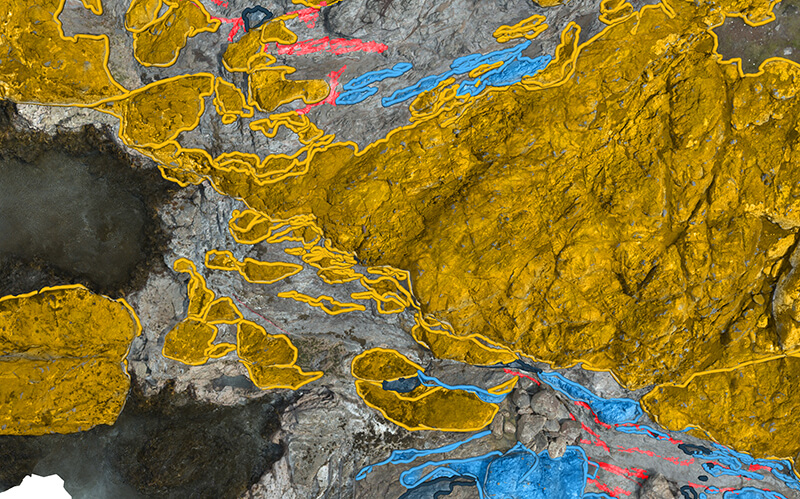
Interpreted photogrammetric model of fragmented sandstone mega-block.
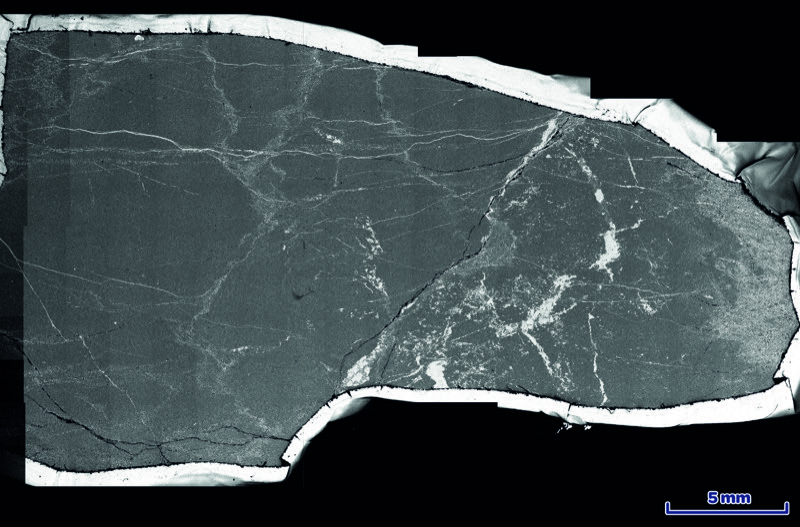
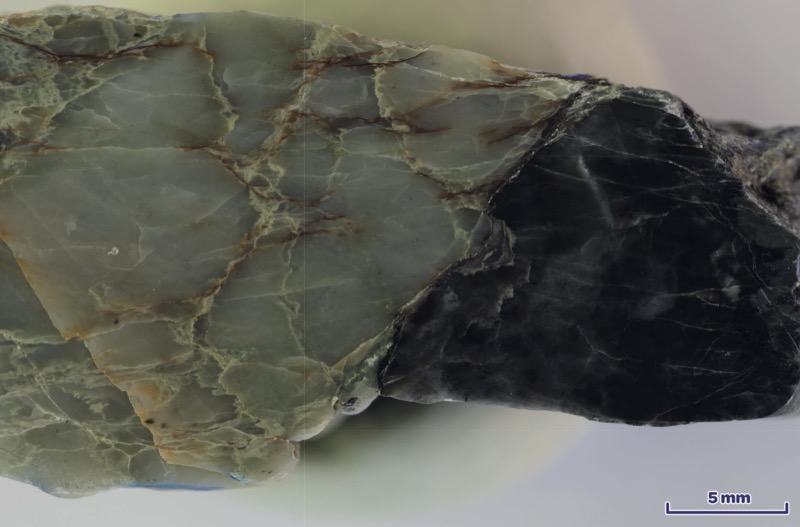
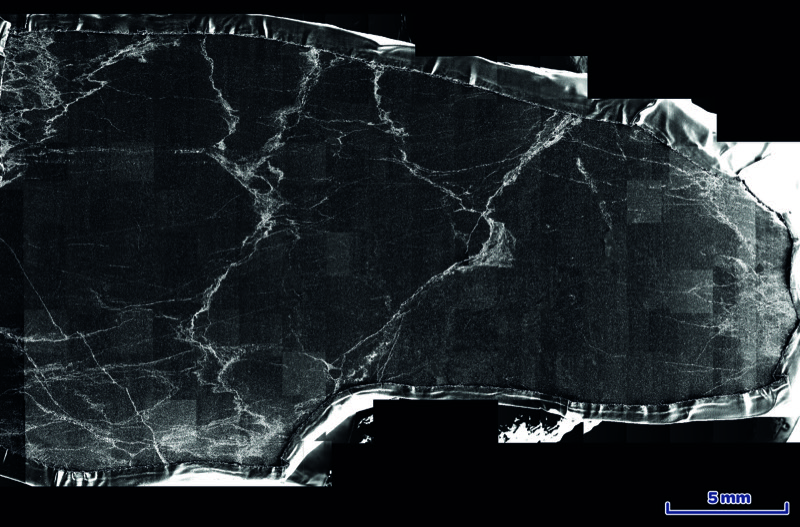
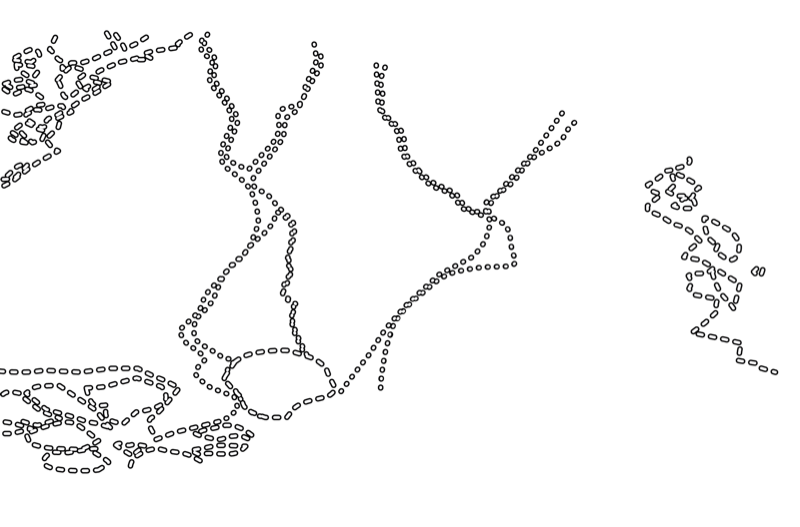
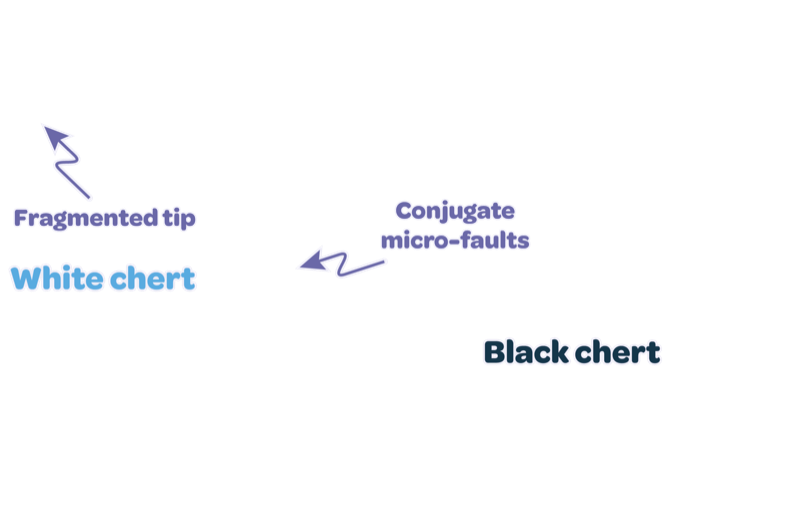
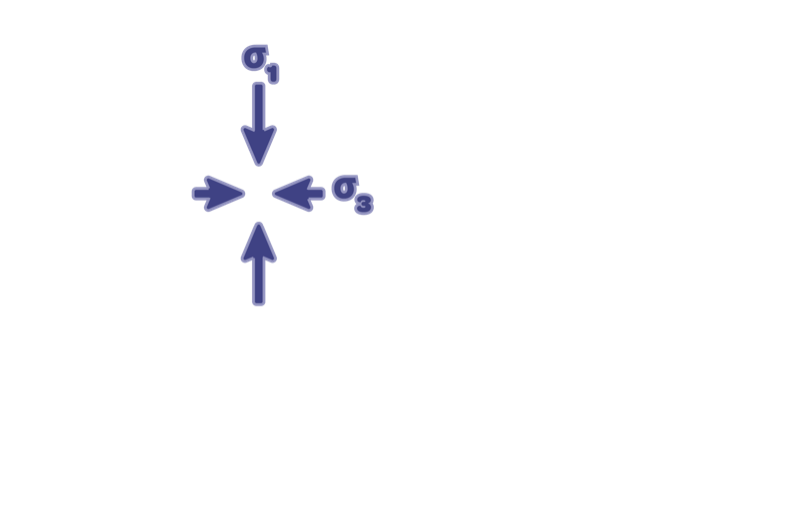
Interpreted SEM-BSE image of a fragmented chert block showing jigsaw fit at the tips & conjugate micro-faults.
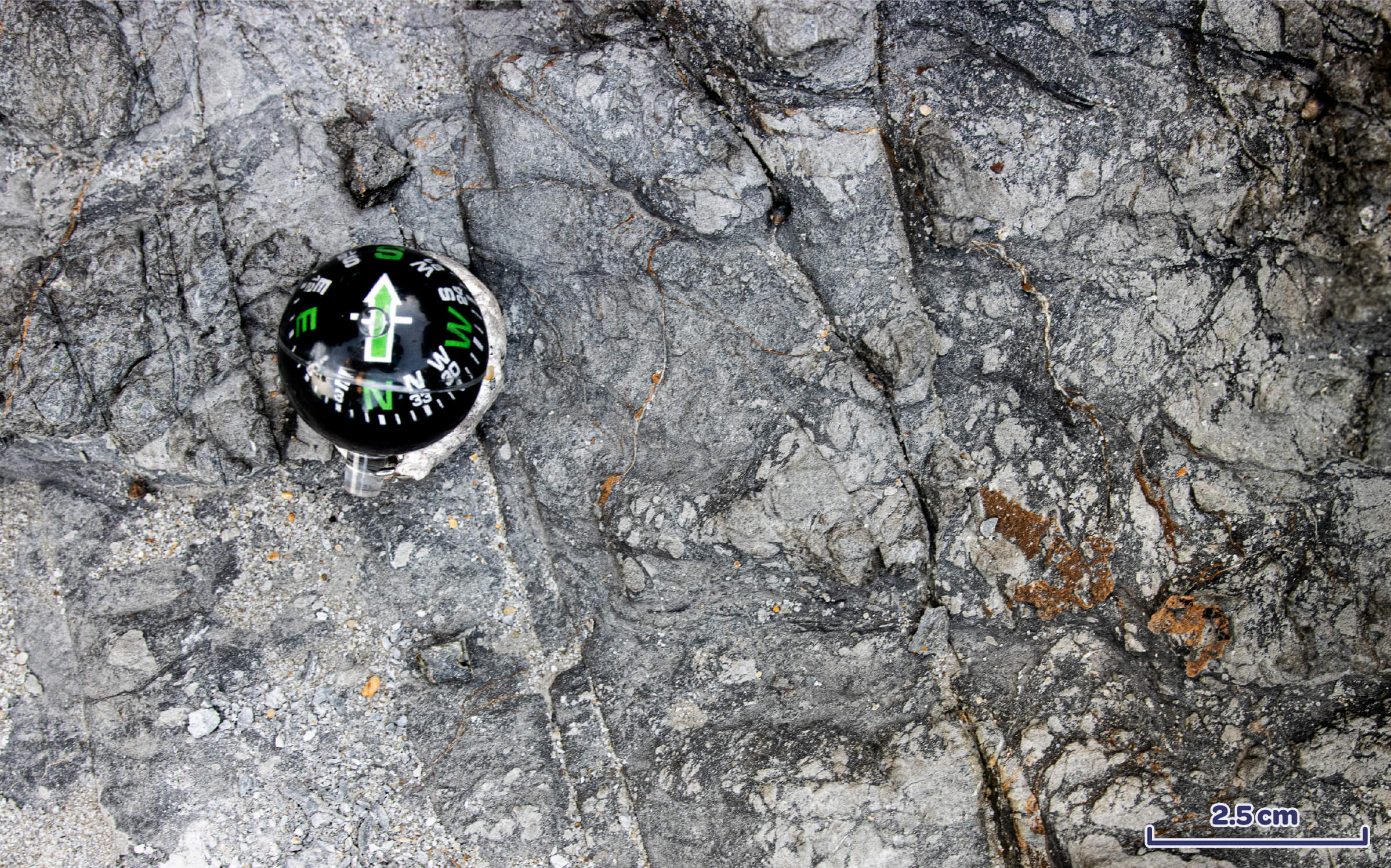
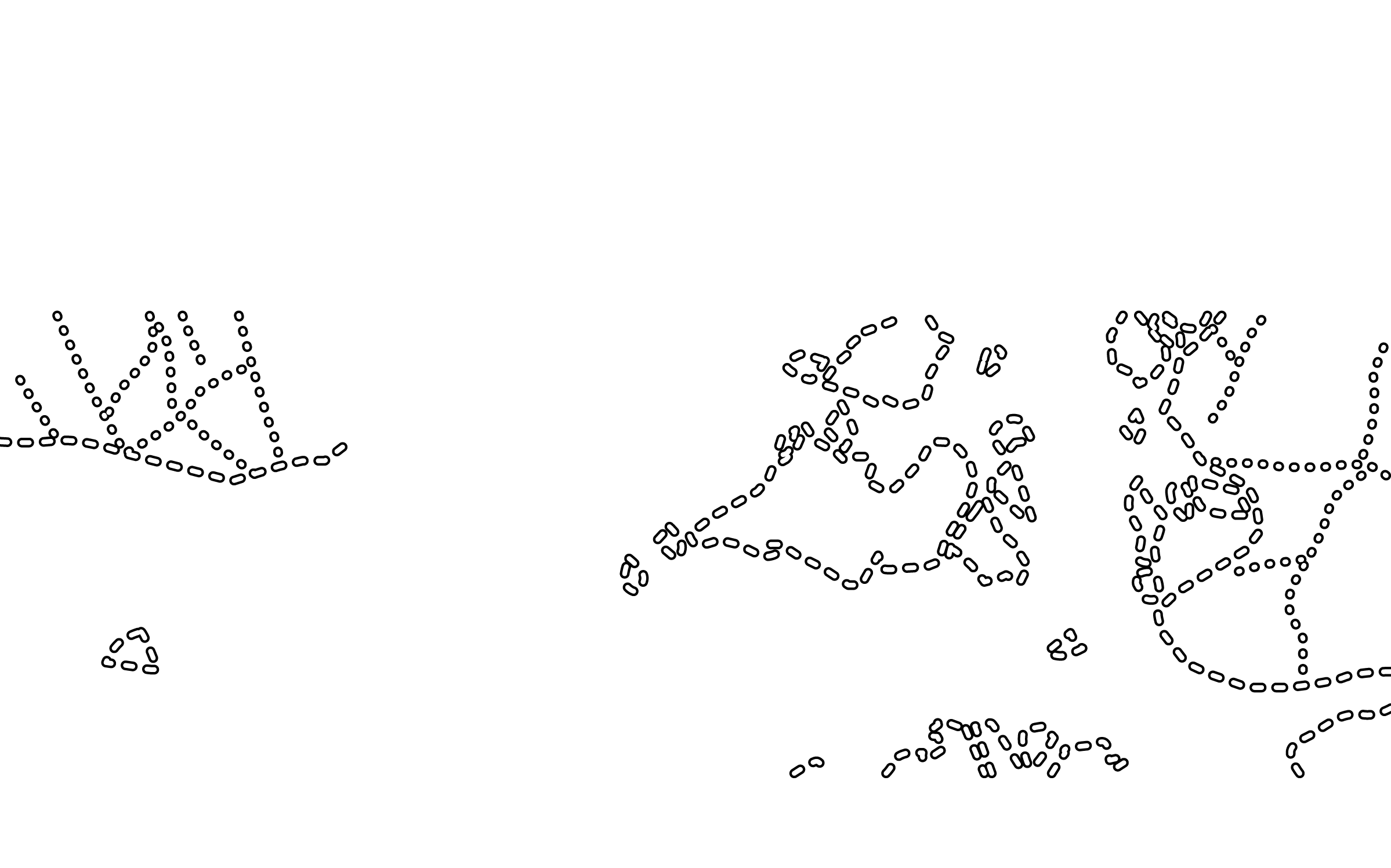
Sandstone mega-block with fragmented margin.
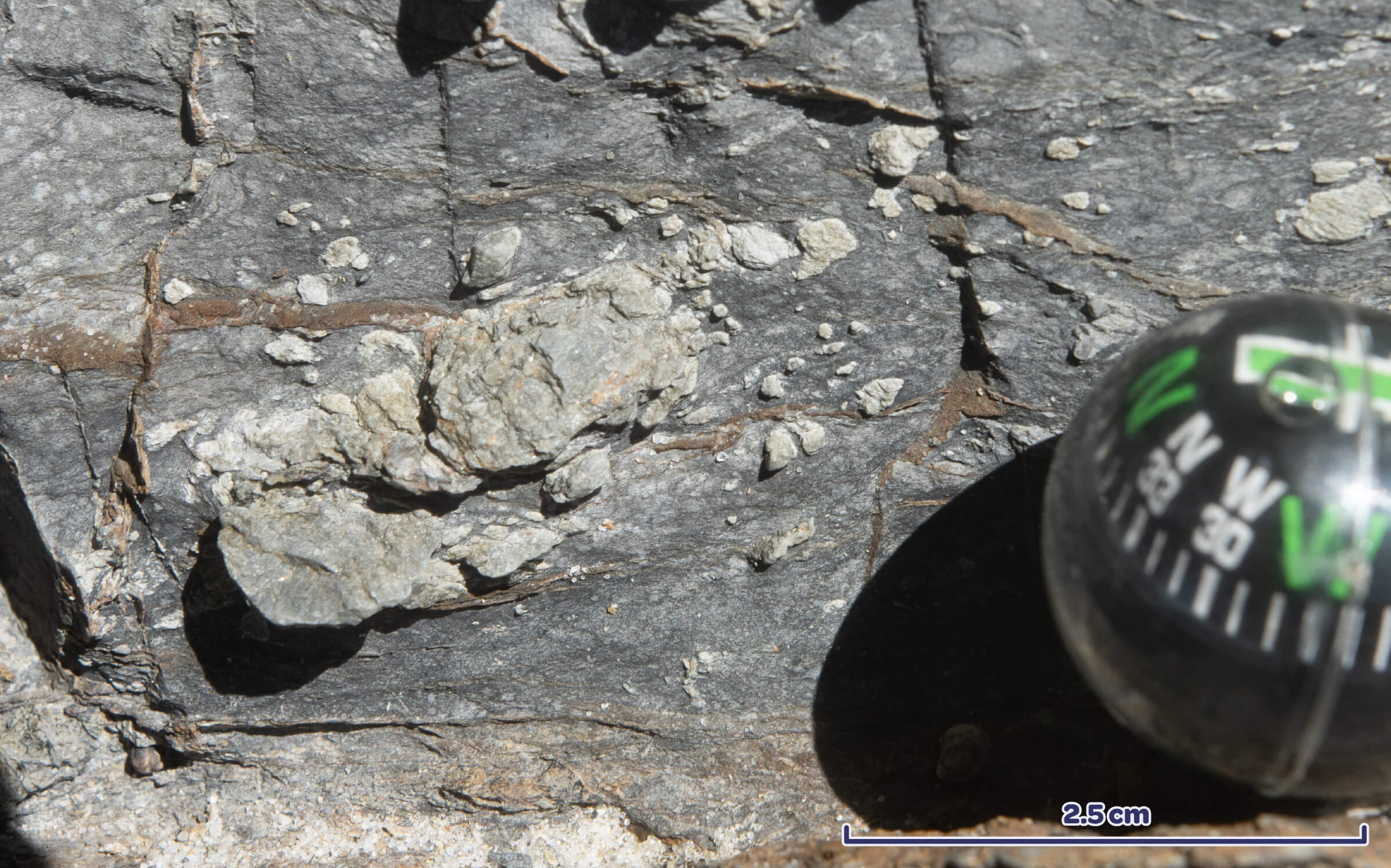
Fragmented clast with jigsaw fit between clasts.
Blocks have weak margins & strong cores
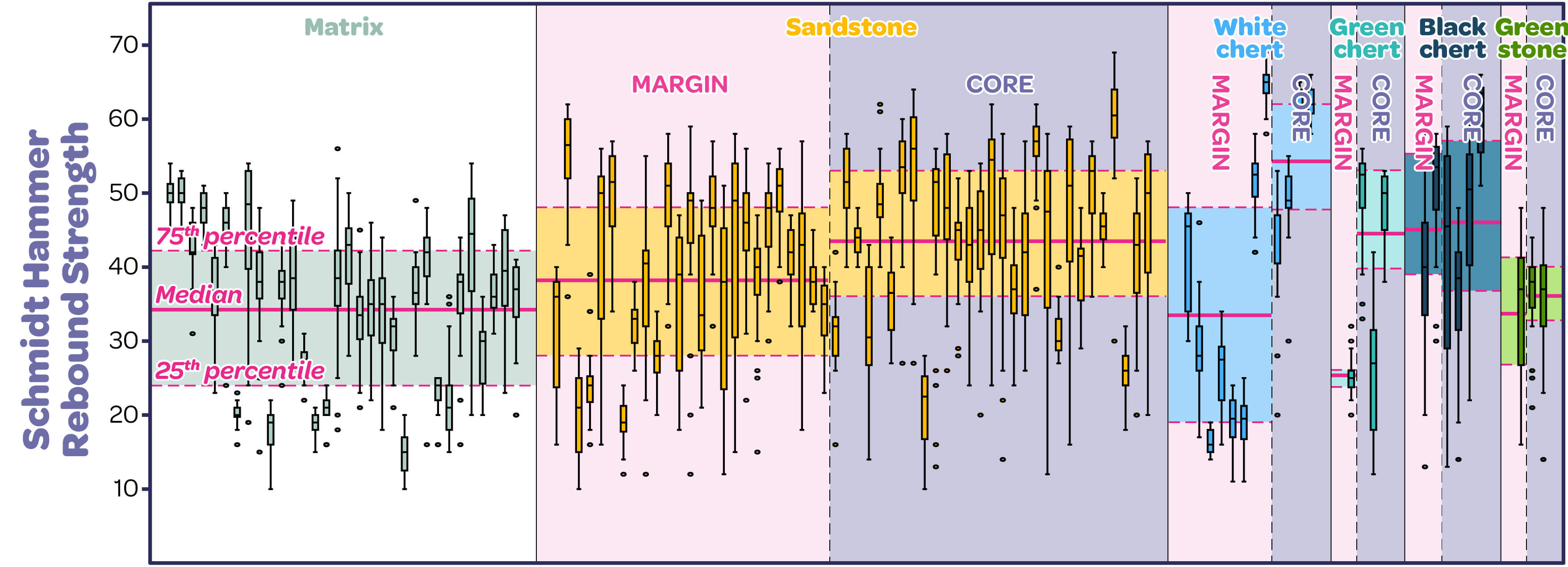
In-situ Schmidt rebound hammer strength results show
Basalt blocks undergo opposite brittle–ductile transition
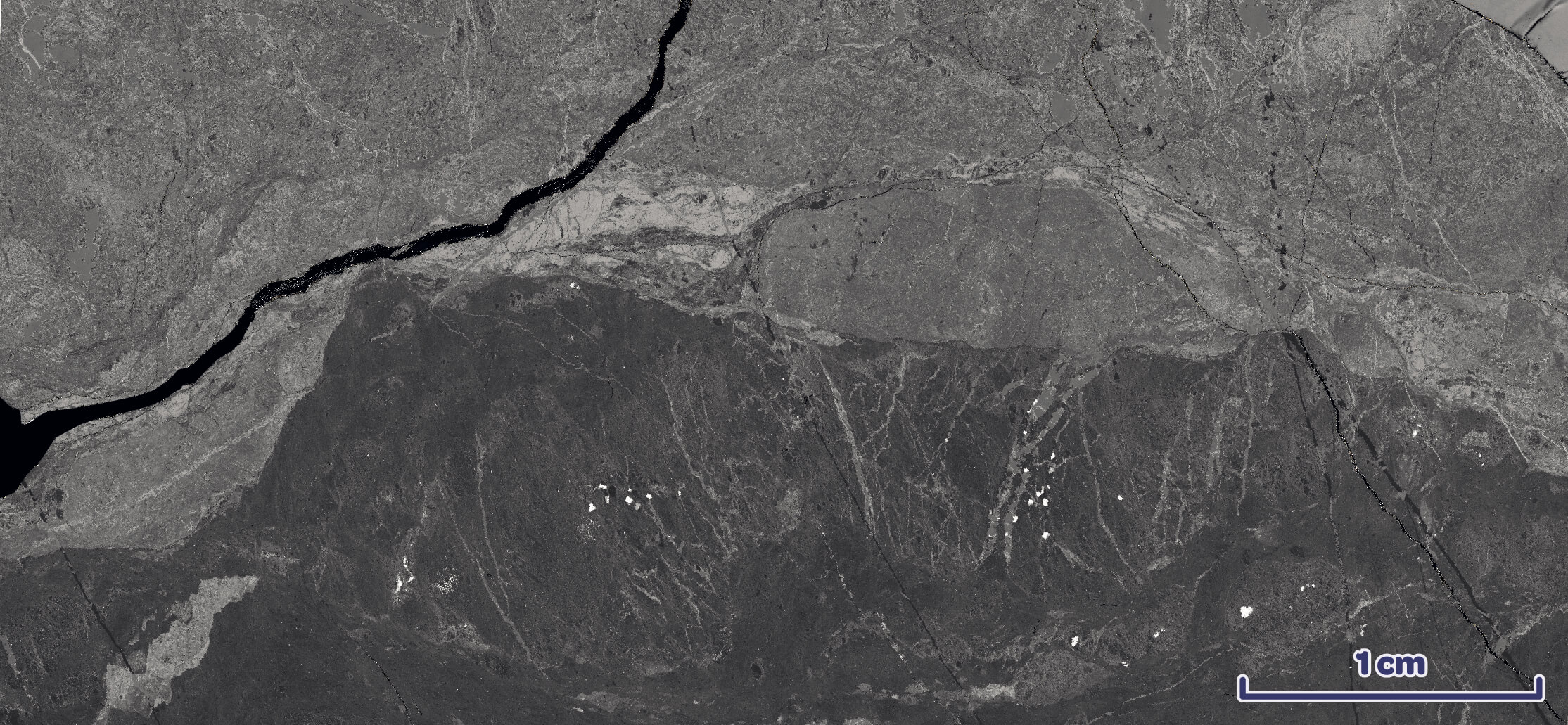
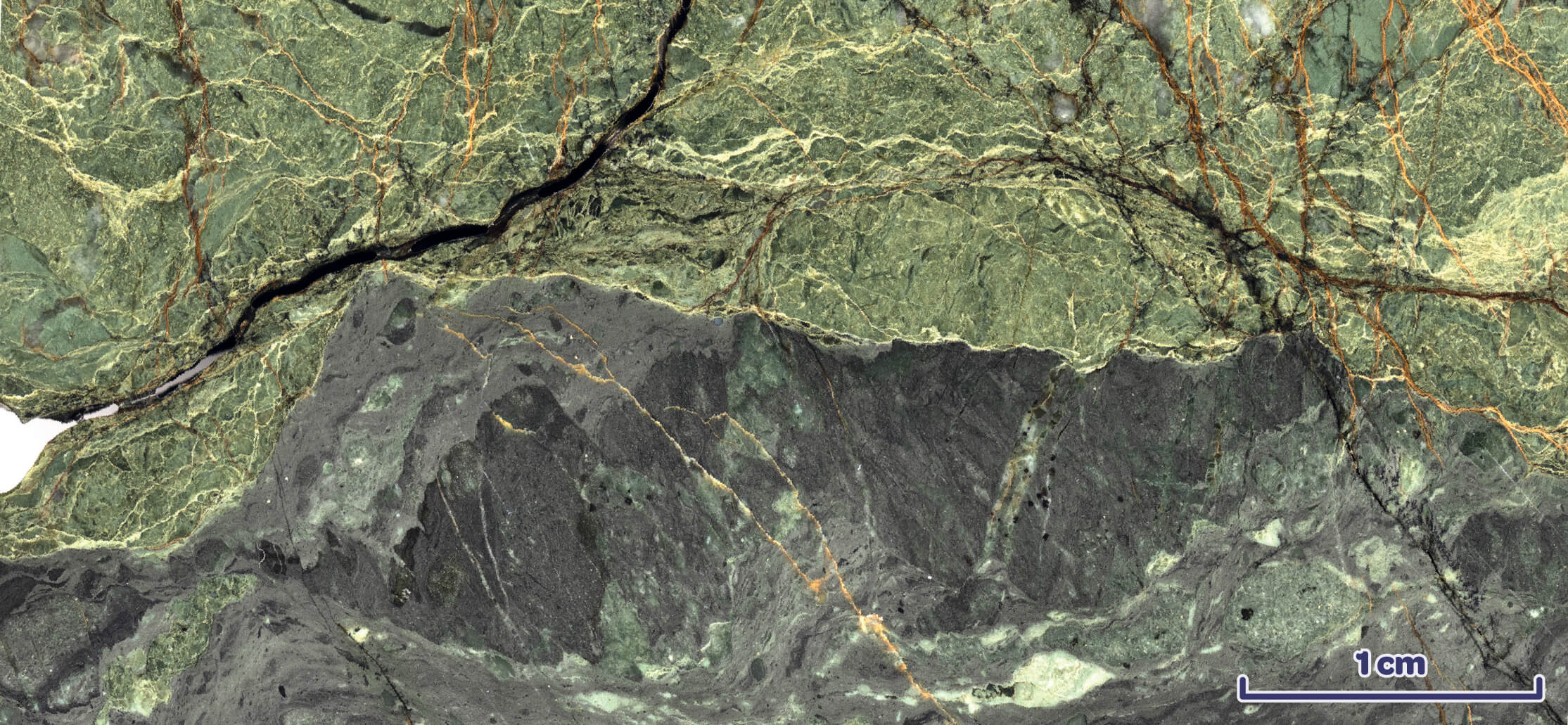
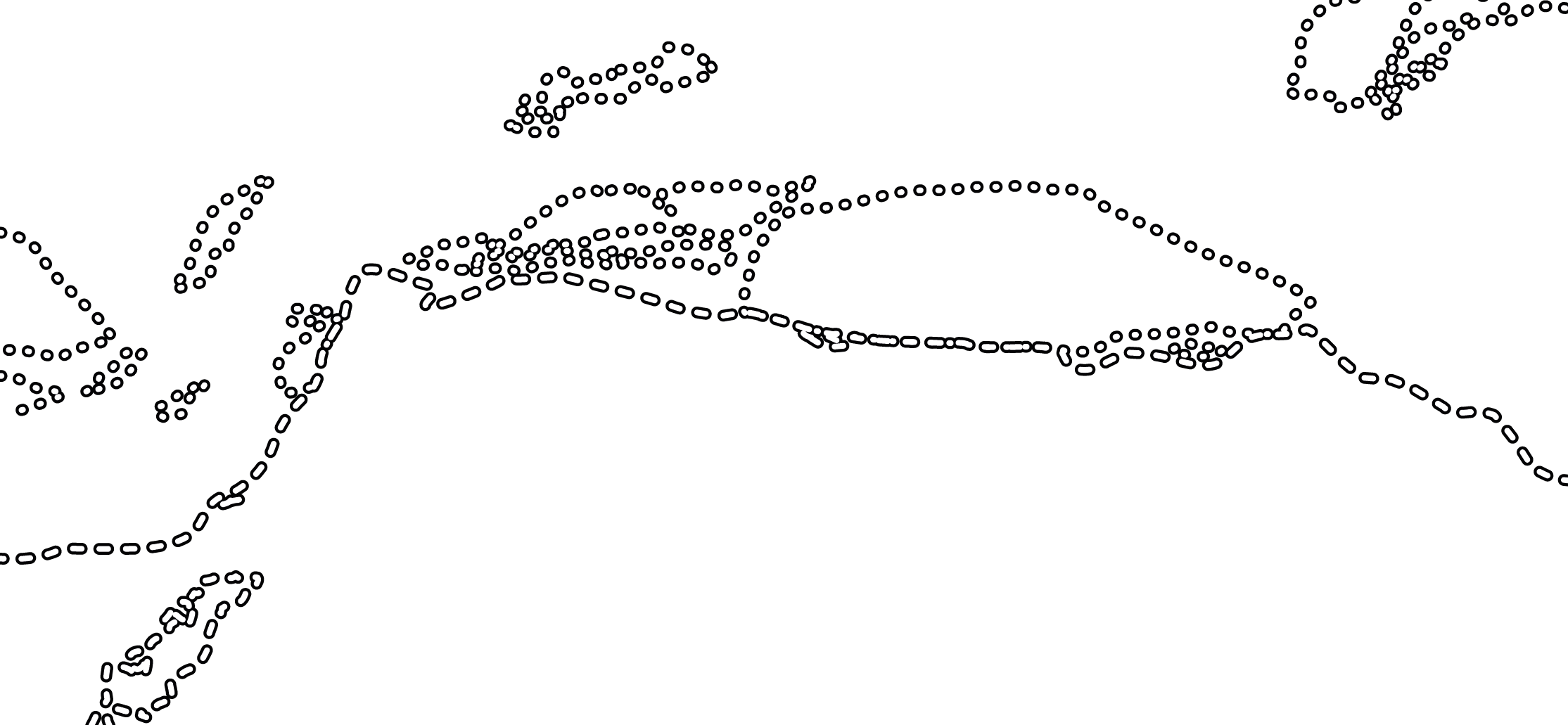
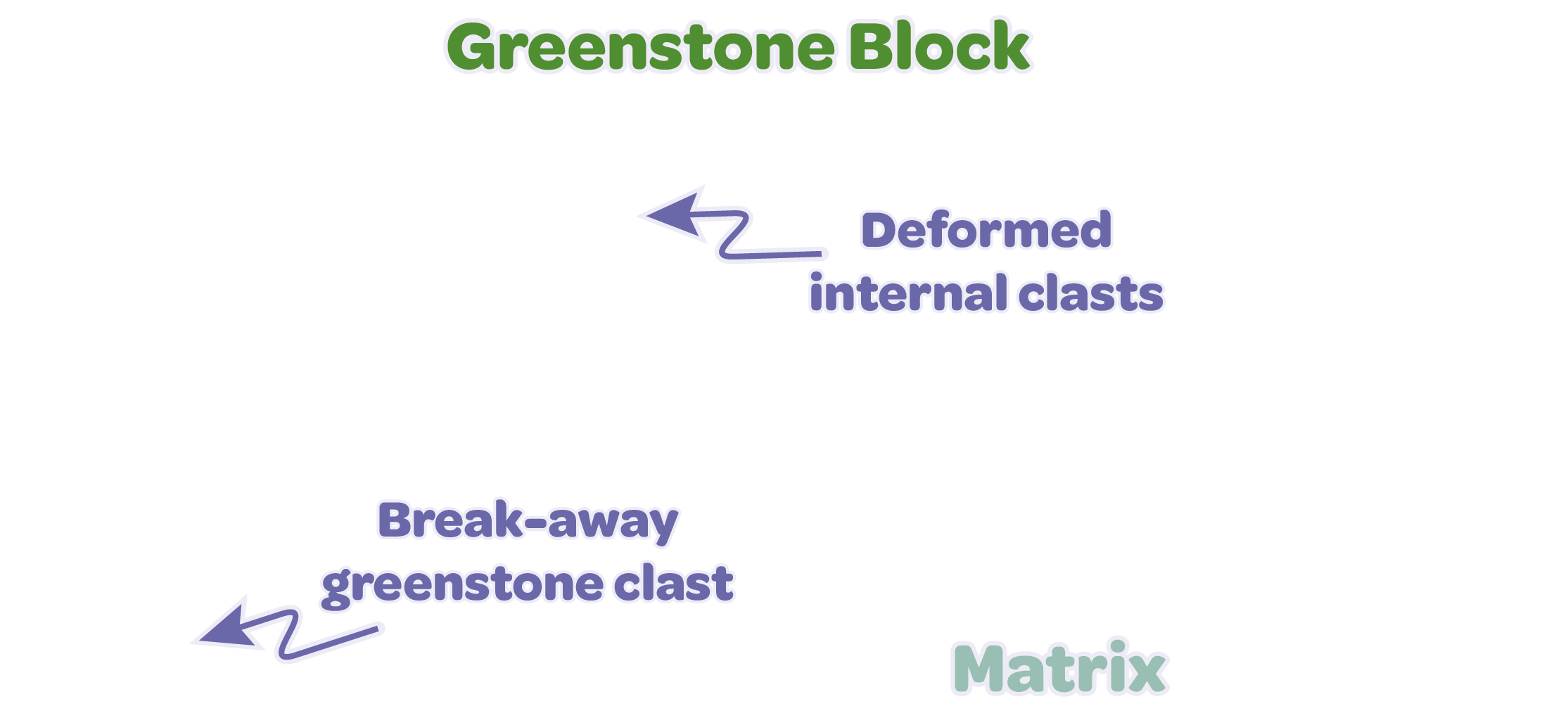
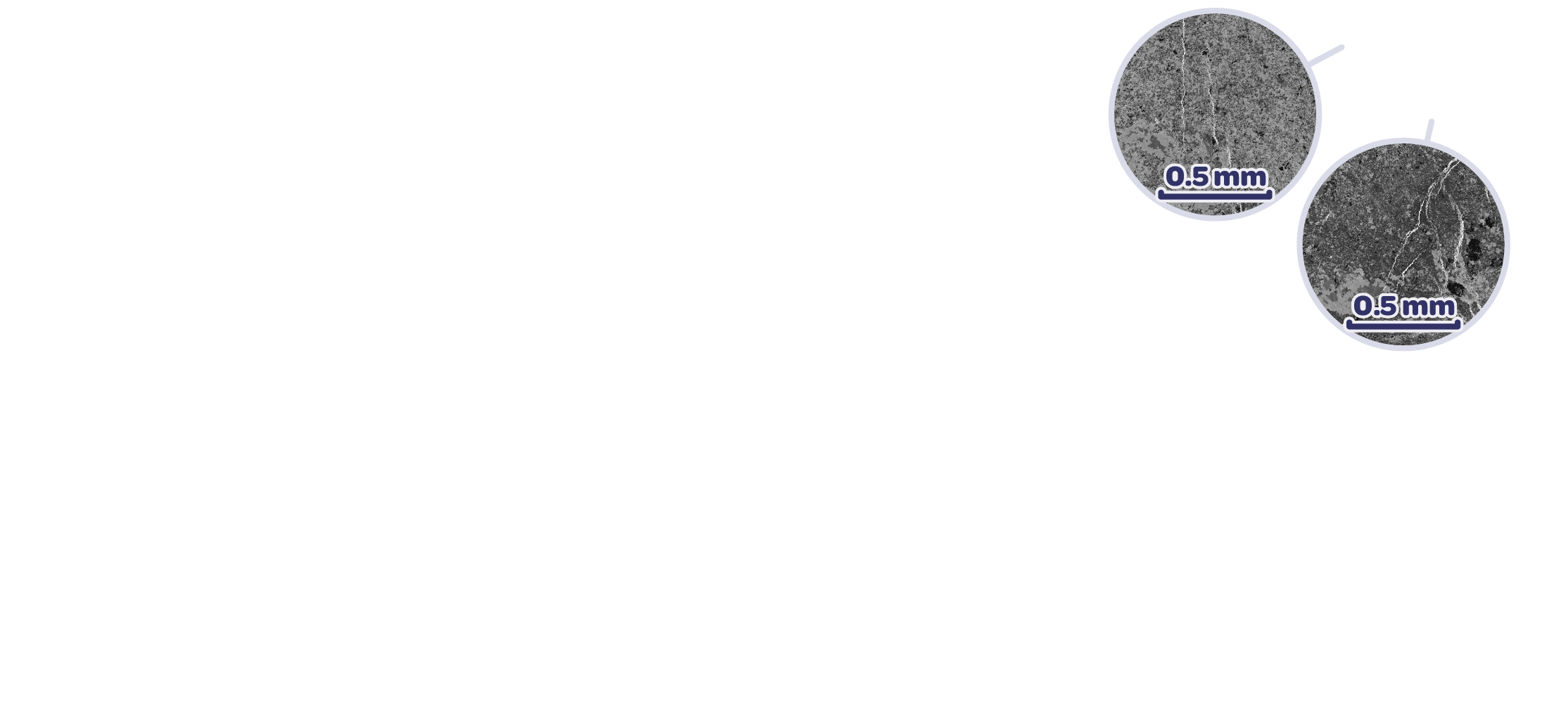
Interpreted SEM-BSE image of altered basalt block showing brecciated texture over-printed by alteration. Fragments of altered basalt show pinch-and-swell & intermingling textures. Insets show relict crystalline texture within internal clast core whereas outside clasts the greenstone is almost entirely altered to clay.
3. Strain Localisation
Continued lithification leads to further localisation of shear, exemplified by stepped shear veins9. As these veins are not themselves deformed, further distributed deformation did not follow formation of these veins.
Shear zones & veins represent localisation of strain away from distributed shear in the matrix
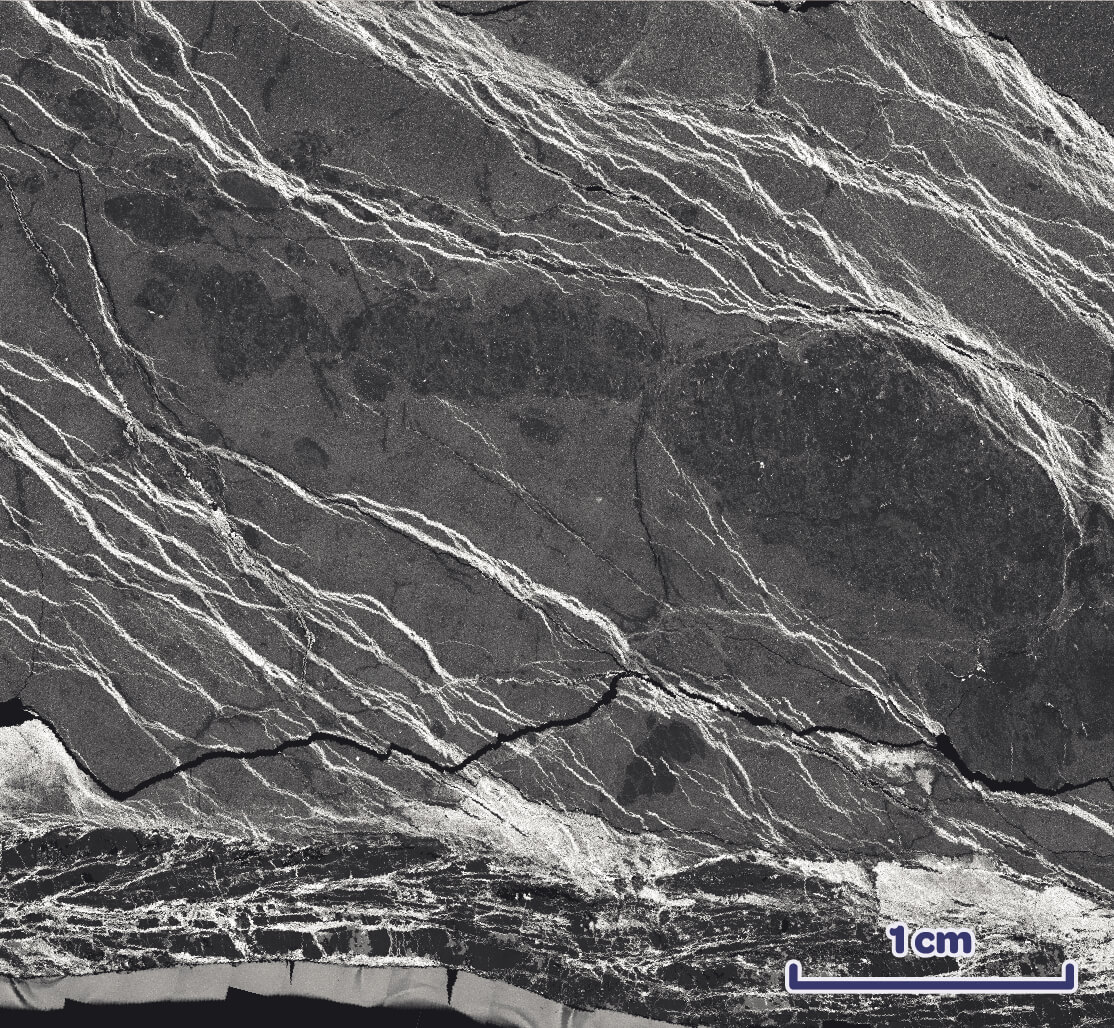
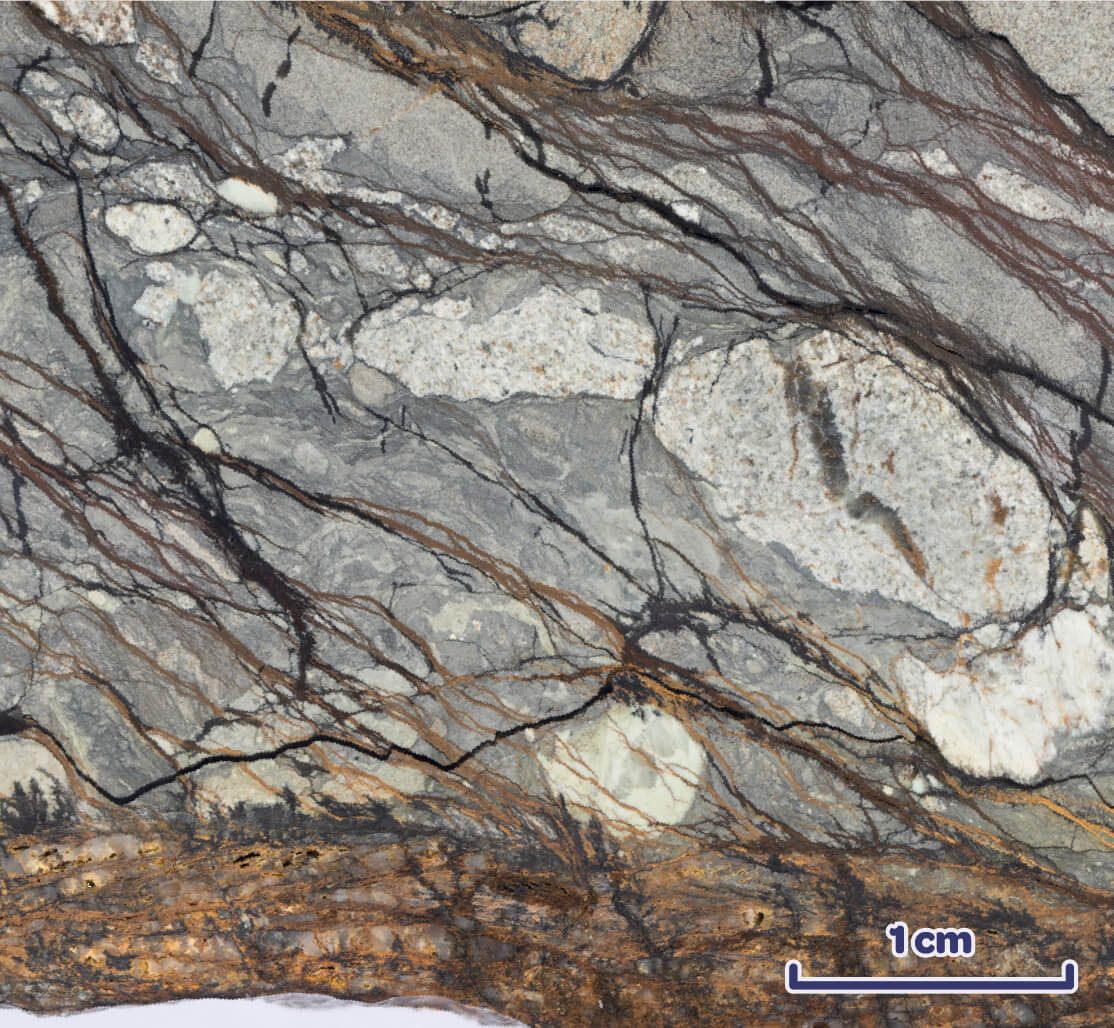
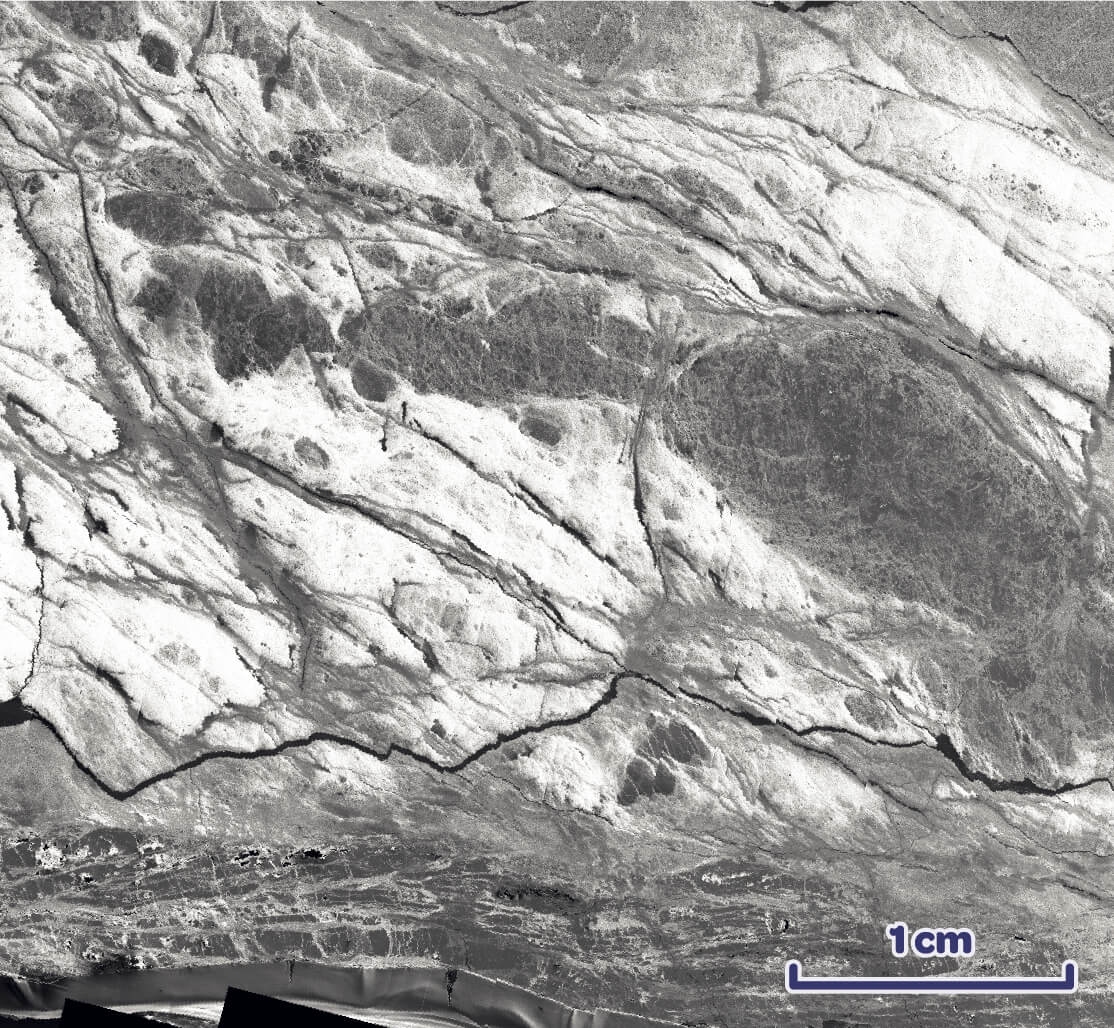

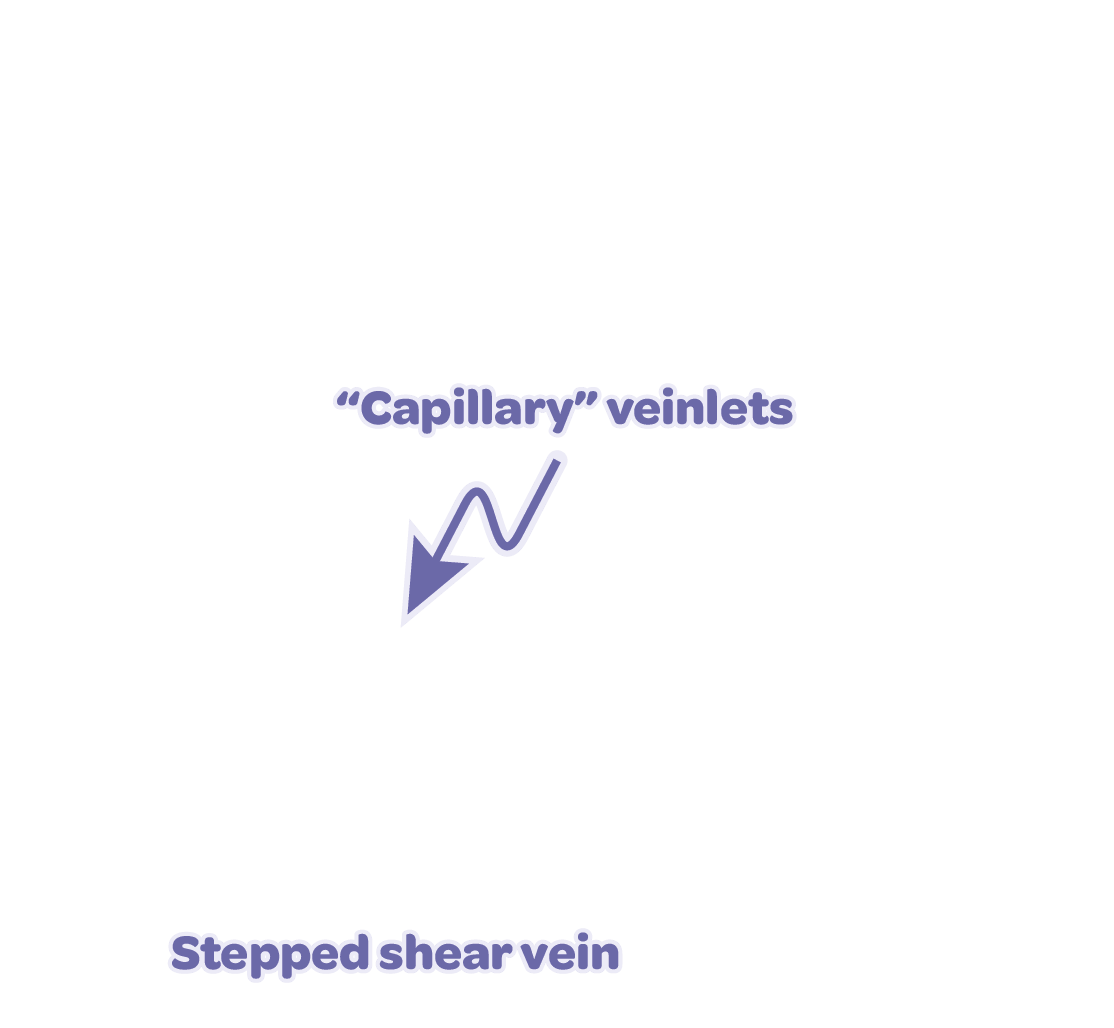
Interpreted SEM-BSE image showing the relationship between a stepped shear vein and the anastomosing “capillary” veinlets.
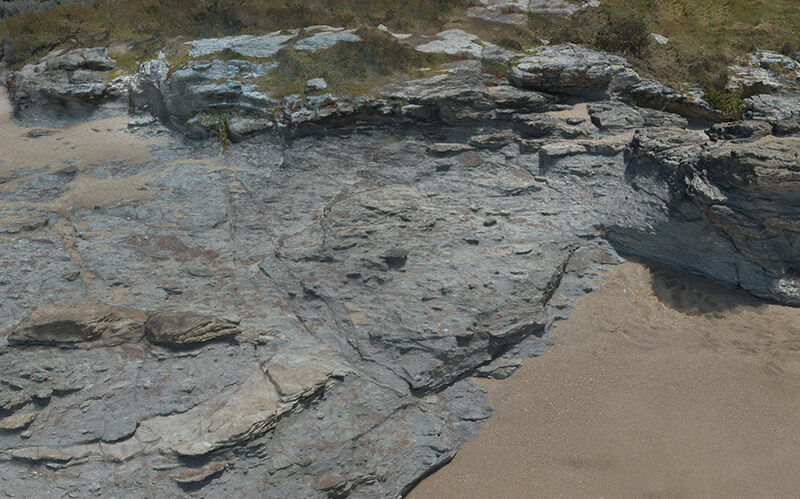
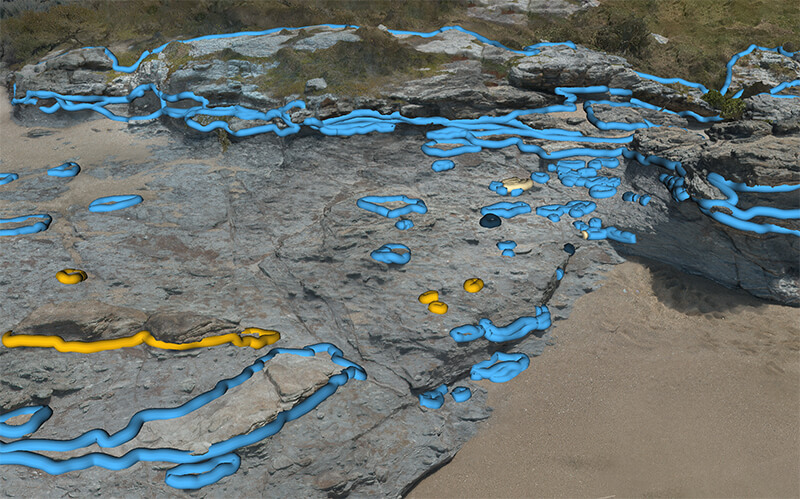
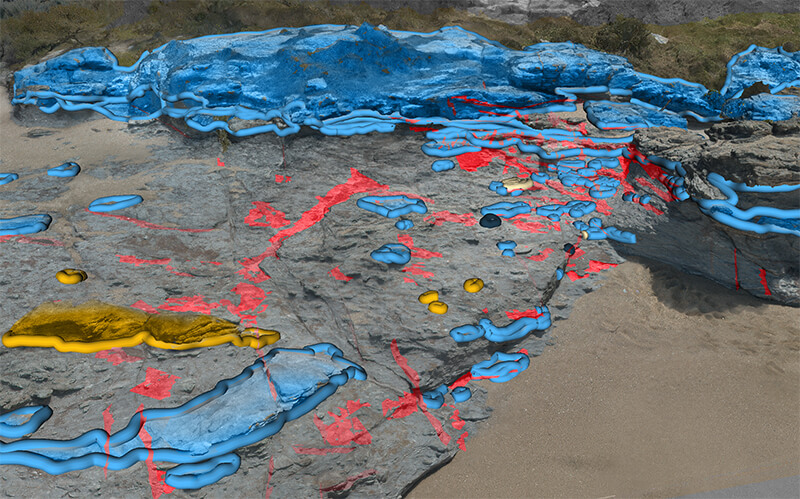
Interpreted photogrammetric model showing anastomosing network of stepped shear veins. These form a network with straight veins in blocks at a high angle to block long axes.
Fluid over-pressure pulses produce complex vein networks
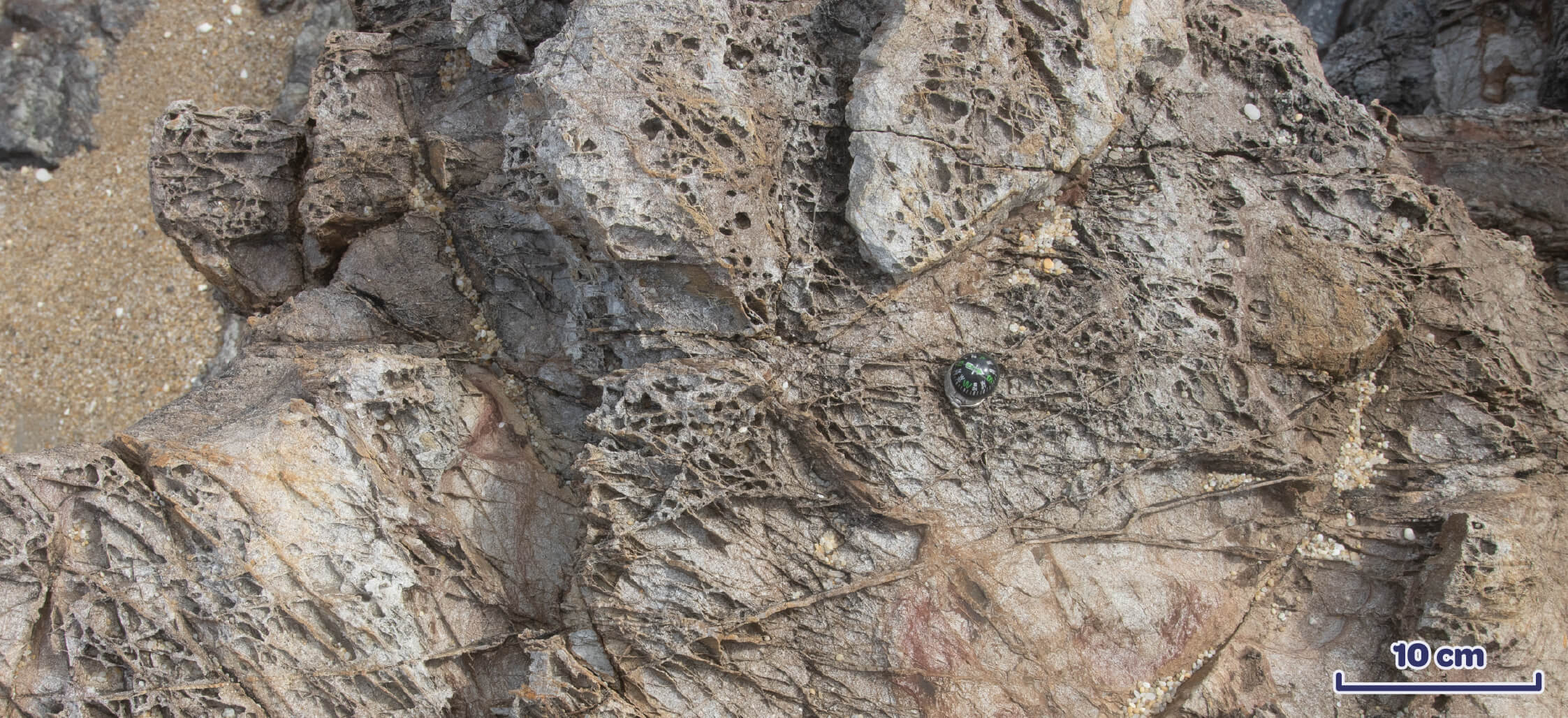
Dense mesh of straight veins within a sandstone block in stockwork pattern consistent with low effective stresses due to fluid over-pressure, possibly due to seismogenic fluid-pressure pulses. In 3D, these veins are more commonly at a high angle to the block long-axes.
Block-on-block contacts are not sites of increased fractures
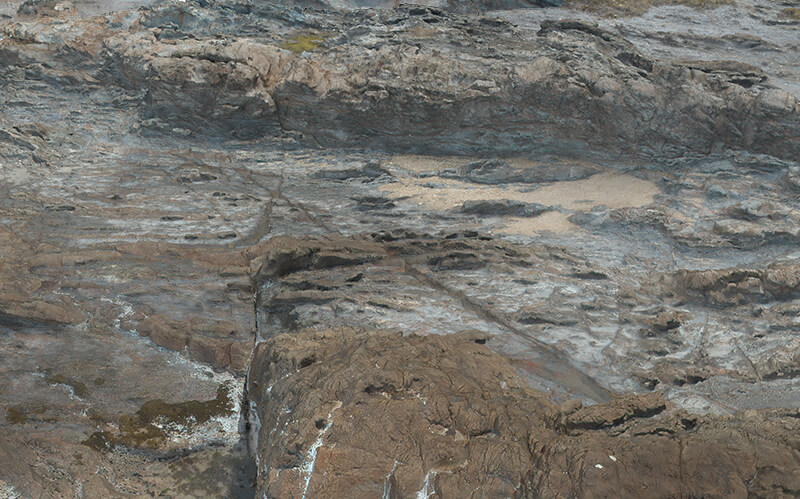
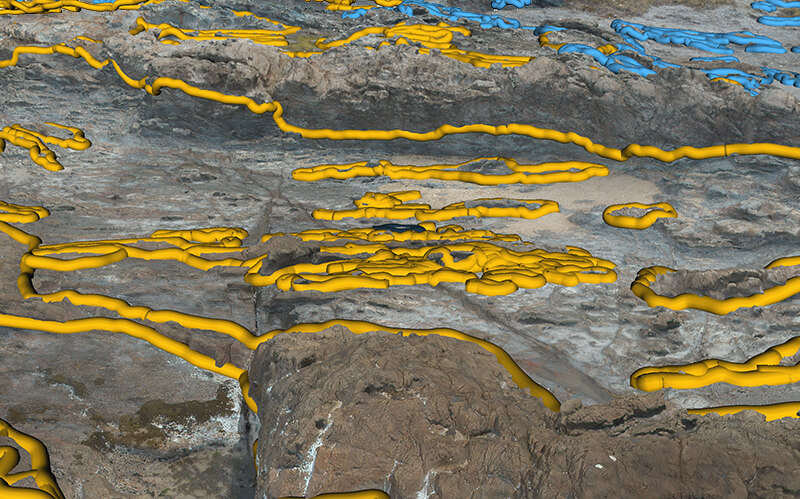
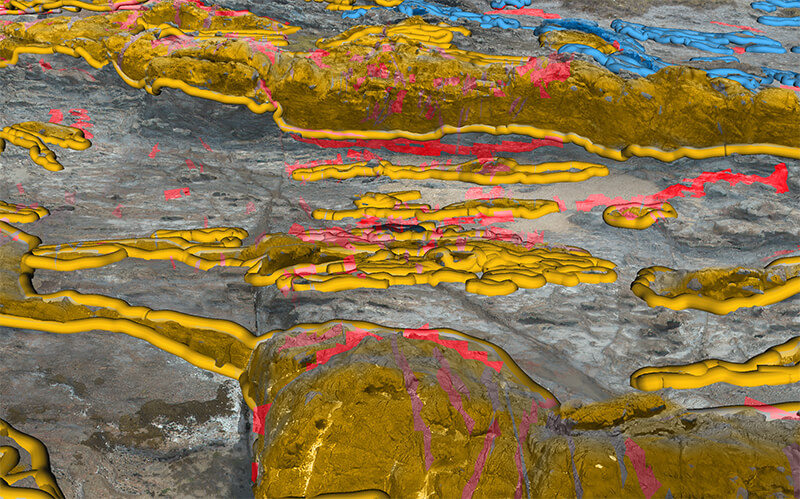
Interpreted photogrammetric model showing no association between block-on-block contacts and increased fracture density. This challenges the notion that primarily blocks break in force-chains due to block-on-block jamming. Instead, the densest vein networks occur in proximity to thick stepped veins.
Conclusions
As blocks can extensively fracture without block-on-block contact, mélanges with low block-to-matrix ratios may also nucleate earthquakes.
Mélange blocks have weaker margins and stronger cores. As such, the rheological contrast at lithological contacts may be less than otherwise expected although they are still often exploited by shear zones.
Rigid blocks in a ductile matrix — the scenario in which jammed blocks break in force-chains — is only one of a spectrum of rheological relationships mélanges may transition through as they subduct.
References
- Fagereng, Å. & Sibson, R. H. Mélange rheology and seismic style. Geology 38, 751–754 (2010).
- Beall, A., Fagereng, Å. & Ellis, S. Fracture and Weakening of Jammed Subduction Shear Zones, Leading to the Generation of Slow Slip Events. Geochem Geophys Geosyst 20, 4869–4884 (2019).
- Vannucchi, P., Clarke, A.P., de Montserrat, A., Ougier-Simonin, A., Aldega, L., Morgan, J.P. A strength inversion origin for non-volcanic tremor. Nat Commun 13, 2311 (2022).
- Hashimoto, Y., Wang, G., Morgan, J. P. & Vannucchi, P. Rheological transitions in FEM models of a block in matrix texture: From stable viscous to localized shear deformation. Preprint at https://doi.org/10.21203/rs.3.rs-6722888/v1 (2025).
- Remitti, F. et al. How deep is the block-in-matrix formation in accretionary prisms? JGS 183, jgs2025-072 (2026).
- Finch, M. A., Olesch-Byrne, A., Chapman, T., Beilharz, M. & Tomkins, A. G. Rheology modification in a subduction channel due to eclogite facies metasomatism (Rocky Beach Metamorphic Mélange, Port Macquarie, Australia). Lithos 488–489, 107797 (2024).
- Nelson, K. D. A suggestion for the origin of mesoscopic fabric in accretionary melange, based on features observed in the Chrystalls Beach Complex, South Island, New Zealand. Geol Soc America Bull 93, 625 (1982).
- Bettelli, G. & Vannucchi, P. Structural style of the offscraped Ligurian oceanic sequences of the Northern Apennines: new hypothesis concerning the development of mélange block-in-matrix fabric. Journal of Structural Geology 25, 371–388 (2003).
- Fagereng, Å., Remitti, F. & Sibson, R. H. Shear veins observed within anisotropic fabric at high angles to the maximum compressive stress. Nature Geosci 3, 482–485 (2010).