My Science
My research investigates the physical heterogeneities of rocks, especially in and around large fault zones and mélanges. The overarching theme of my research is how heterogeneities in material properties (e.g. strength), heterogeneities in rock structure (e.g. fractures), and heterogeneities in fluid flow and pressurisation interact to determine how that rock mass behaves when stressed.
Large faults and subduction zones present one of the most dangerous natural hazards on our planet but also provide fundamental resources such as critical minerals and geothermal energy. I take a highly holistic and multidisciplinary approach to my research, integrating field-based structural geology with microscopy, petrology, rock mechanics, photogrammetry, and numerical modelling.
I am especially interested in 3D reconstructions of rocks and outcrops which allow detailed, realistic, and quantifiable models of natural phenomena. In addition to my geology research, I also work on developing methodologies to assess and compare the accuracy and quality of photogrammetric models.
Mélanges
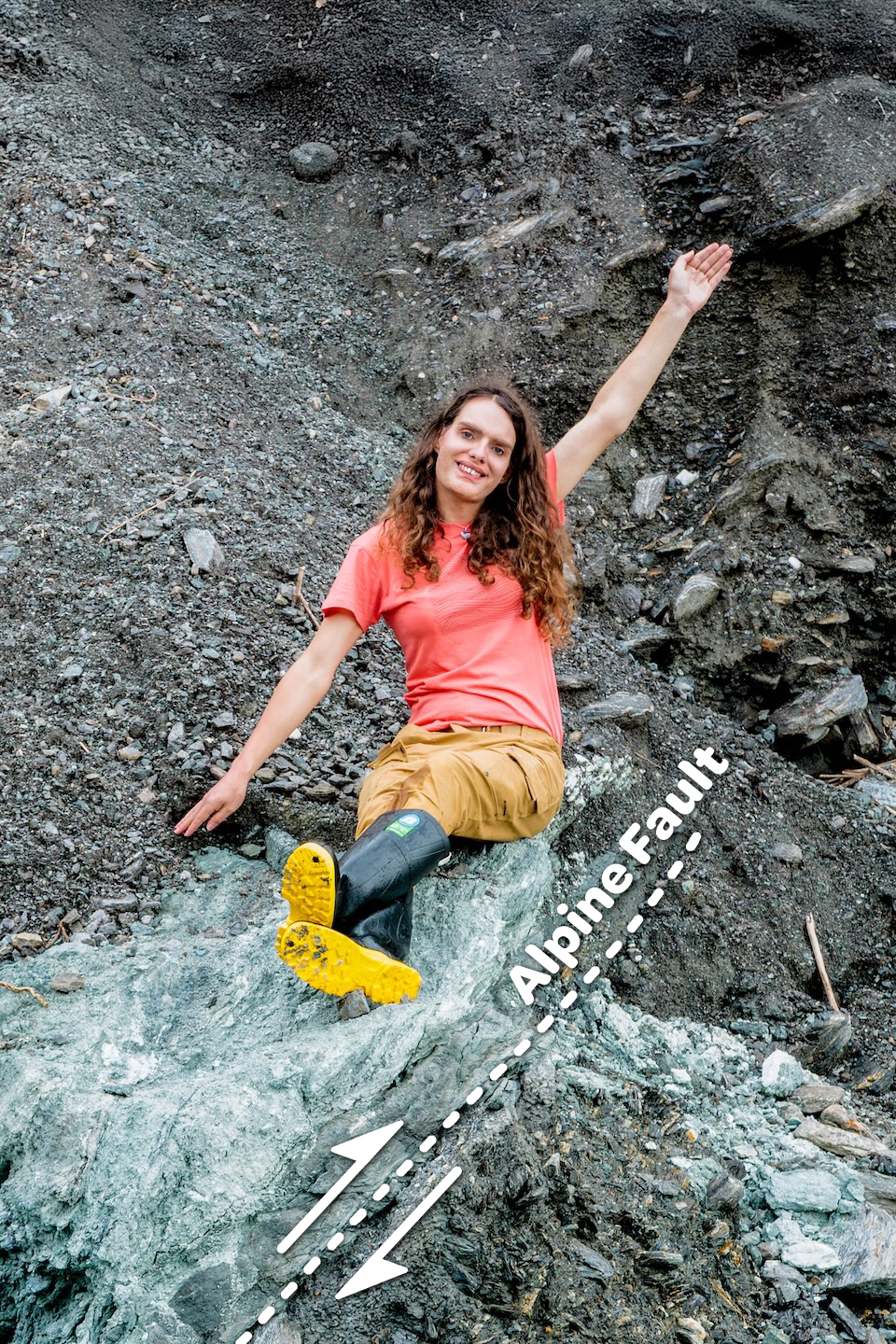
Much of my research focusses on mélanges — typically the mega-scale remnants of plate-boundary-scale faults — which are the archetypal heterogenous rock unit being composed of metre – hundreds of metre sized blocks of one rock type within a matrix of another. I have worked on the Chrystalls Beach Mélange in New Zealand, the Osa Mélange in Costa Rica, and the Gwna Mélange in Wales. Most of my research on these rock units involves mechanical strength tests and micro-structural analysis to determine the present and past rheological relationships between blocks and matrix.
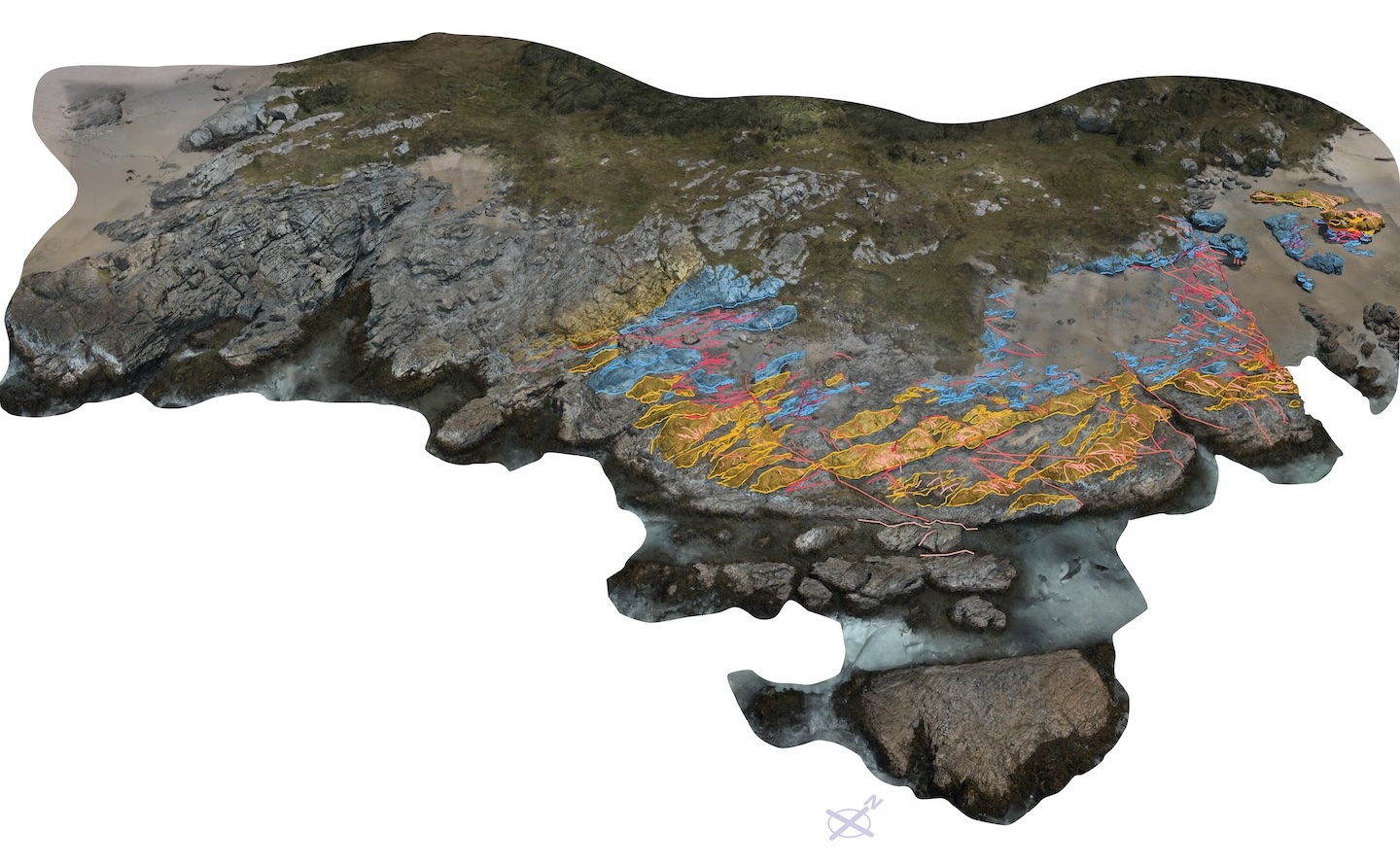
Interpreted outcrop model from the Chrystalls Beach Mélange
Interpreted outcrop model from the Chrystalls Beach Mélange, New Zealand, showing sandstone (yellow) and chert (blue) blocks cut by an anastomosing network of veins and fractures (red and pink).
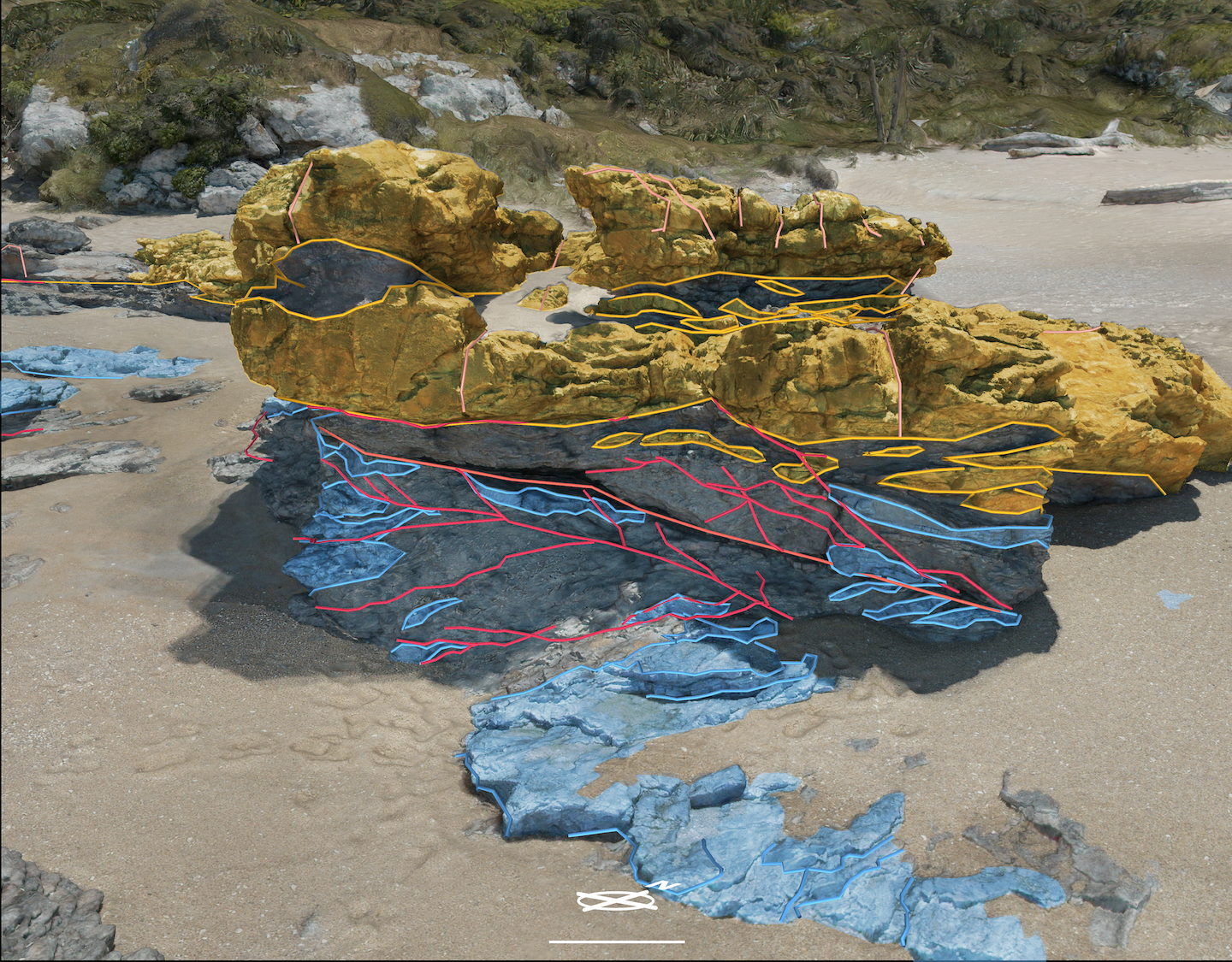
Interpreted outcrop model from the Chrystalls Beach Mélange
Interpreted outcrop model from the Chrystalls Beach Mélange, New Zealand, showing sandstone (yellow) and chert (blue) blocks cut by an anastomosing network of veins and fractures (red and pink).
Fault Zones
My research also focuses on characterising the structural heterogeneity in other fault zones. While faults are typically envisaged as discrete planes, perhaps with some off-fault damage either side, diligent analysis of faults in outcrop reveals that most faults are complex, heterogenous, and highly varied. My research into this variability between faults and heterogeneity within faults is led by detailed and quantitative characterisation of outcrops using fieldwork, virtual outcrop models, and statistical analysis to show what faults actually look like and how they behave in response to stresses and as pathways/barriers to fluids. Much of this research is part of the BMWK-funded RESTLESS project into induced earthquakes in the Upper Rhine Graben in response to hydrothermal exploitation.
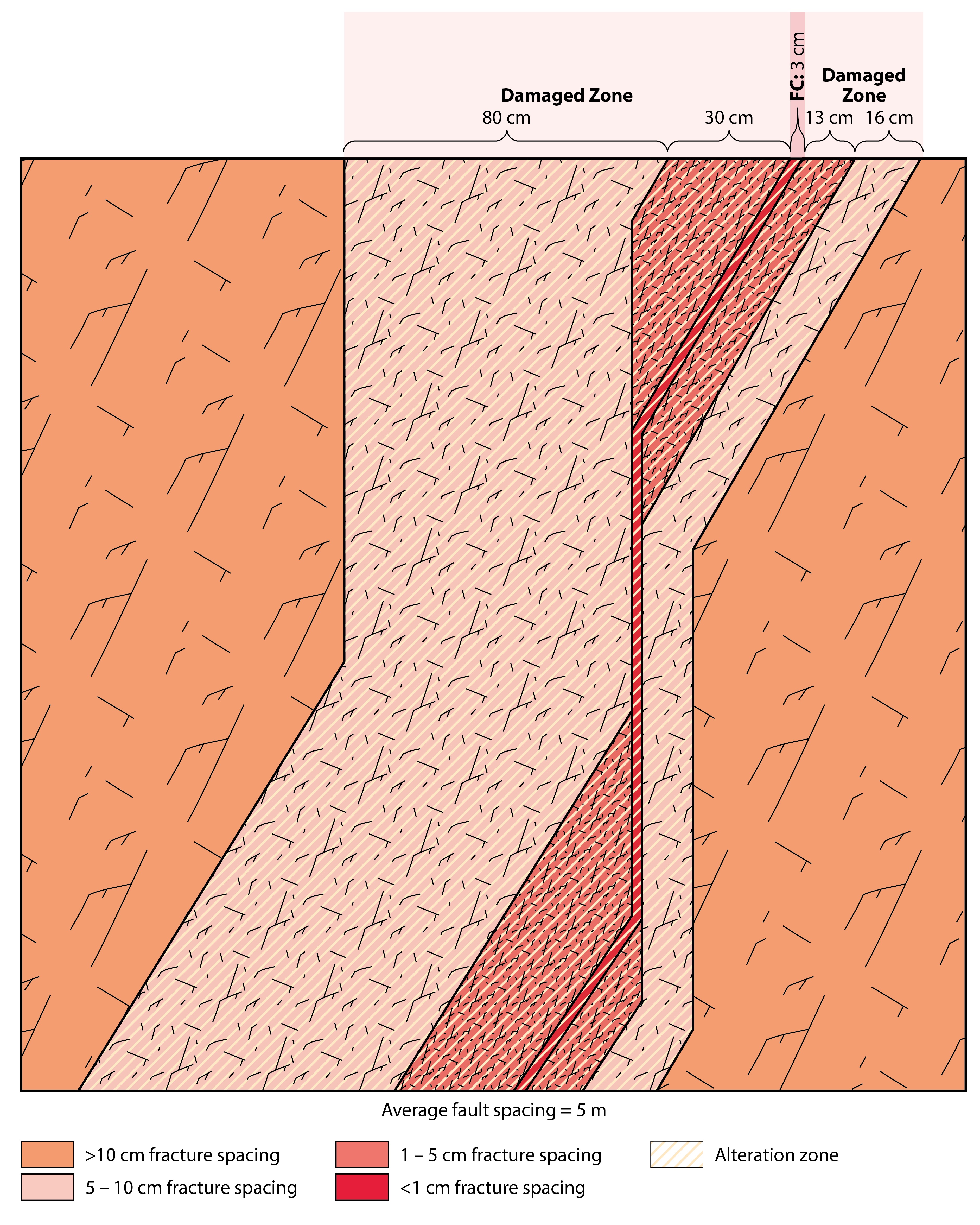
Schematic Model of Fault Zone in Gneiss
A schematic and statistical fault zone model for a quarry outcrop in the Schwarzwald.
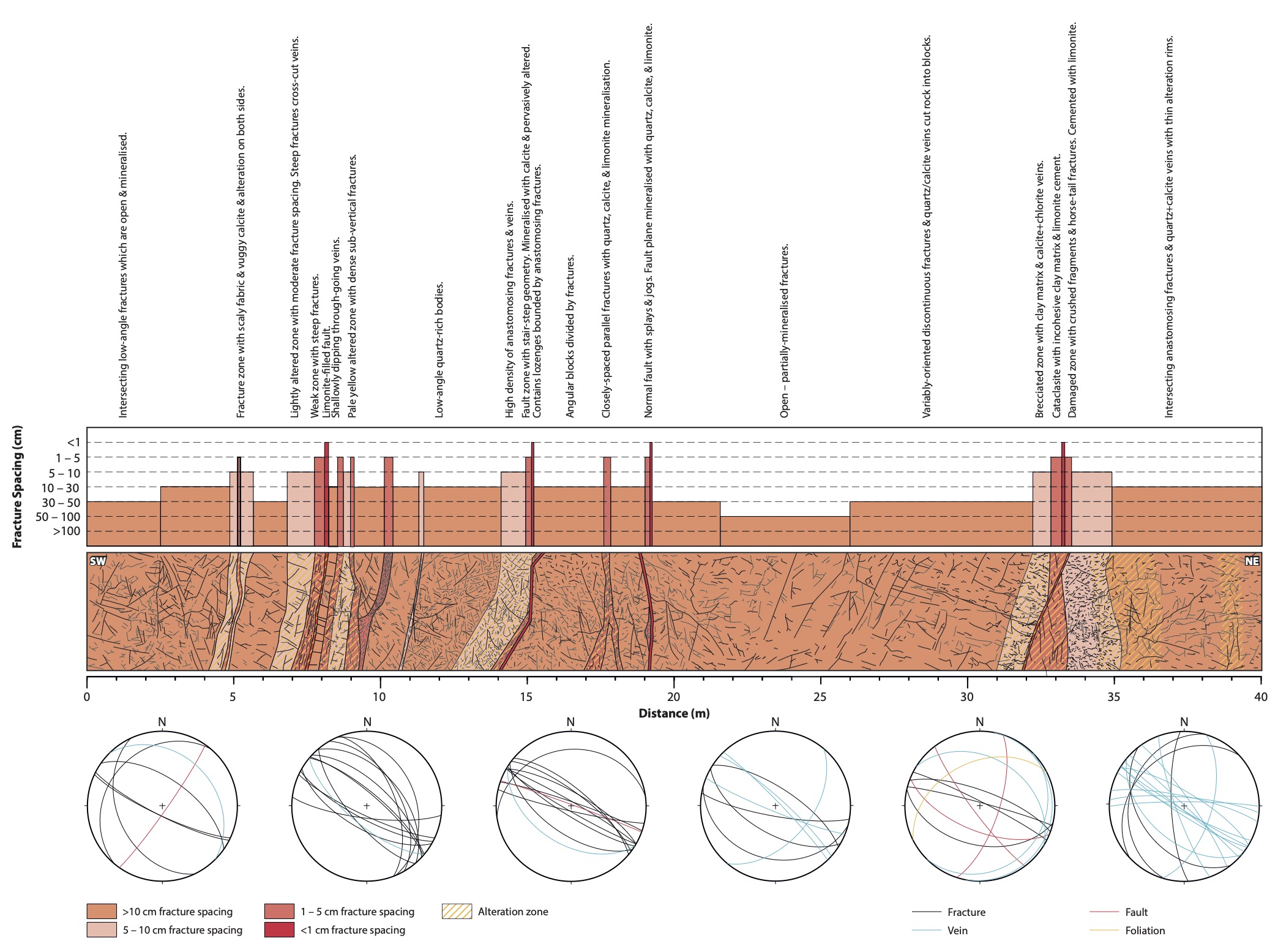
Interpreted Fault Zone in Gneiss
A detailed interpreted fault zone for a gneiss quarry outcrop in the Schwarzwald.
Virtual Outcrops & Samples
Virtual outcrop models are a fundamental part of my research and have become a common tool for many field-based structural geologists. Photogrammetry is a simple and mostly automated method to construct virtual outcrop models; however, the quality of these models can vary dramatically depending on how the photos were taken and the settings and procedures used in the photogrammetric software. My research empirically evaluates how image acquisition and model construction parameters influences model quality. The quality of a photogrammetric has a major impact on the accuracy of the analysis done on it; as such, my research also quantitatively investigates the accuracy and repeatability of photogrammetric surveys and I have developed methods to quantify the accuracy of models across scales.
See more virtual outcrop and sample research
Rock Mechanics
The rock units I study are very heterogenous and I use rock mechanics experiments to characterise the variability in their mechanical properties. Most rock mechanics experiments are done in a lab with precisely prepared samples. To fully characterise heterogenous rock units this way requires a very large number of samples and tests. Sampling and preparation processes also risk introducing biases as the strongest rocks cannot easily be recovered from the outcrop and the weakest rocks do not survive sampling and preparation. The processes of sampling and preparation also introduce damage which cannot be accounted for. As such, my research includes in-situ measurements from systematically distributed sites and statistical analysis — calibrated with lab-based experiments — to overcome these challenges.
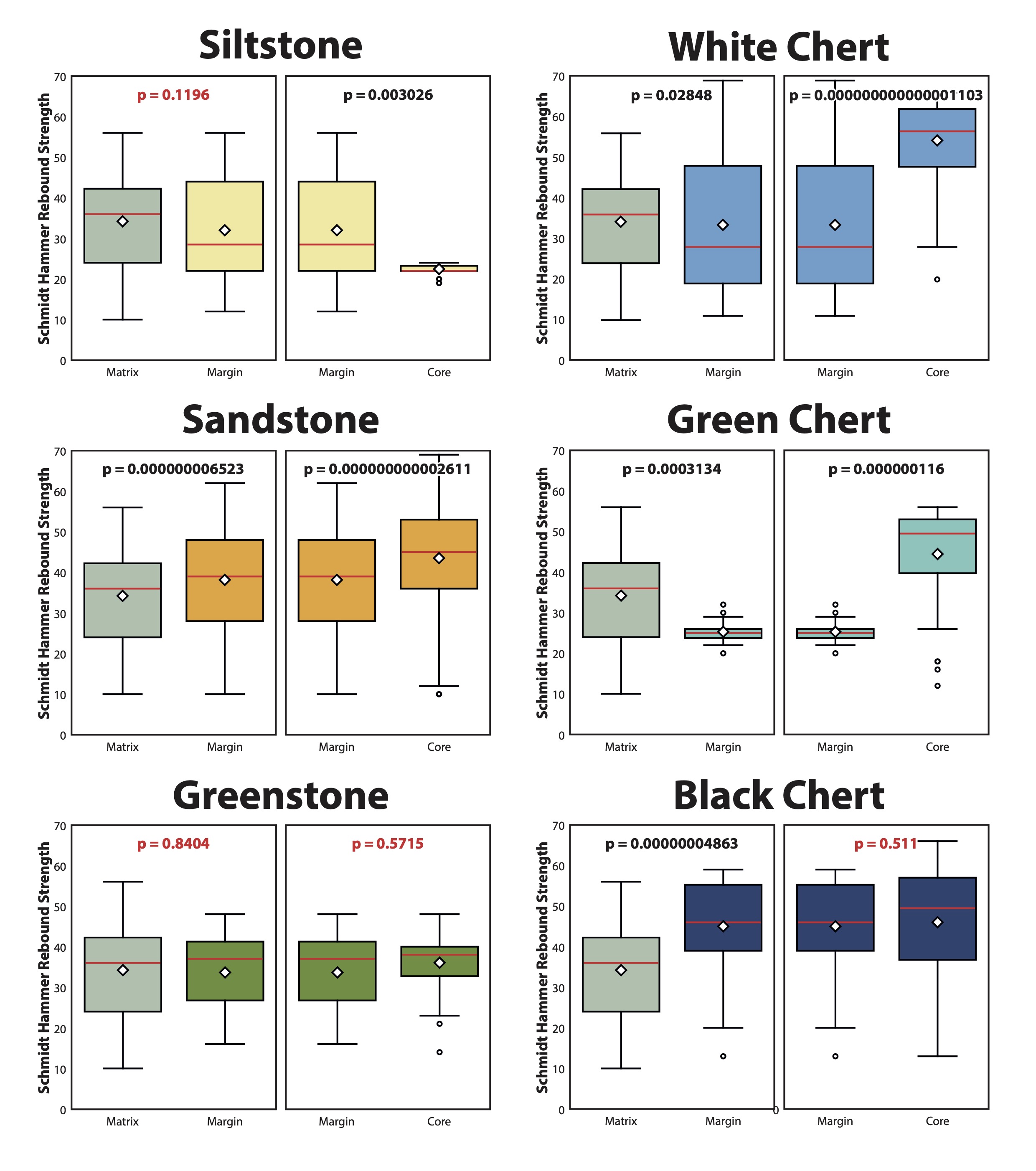
Mélange Heterogeneity Revealed by Schmidt Hammer Strength Tests
In-situ strength tests of blocks and matrix in the Chrystalls Beach Mélange, New Zealand showing systematic differences between the strengths of block cores and margins.
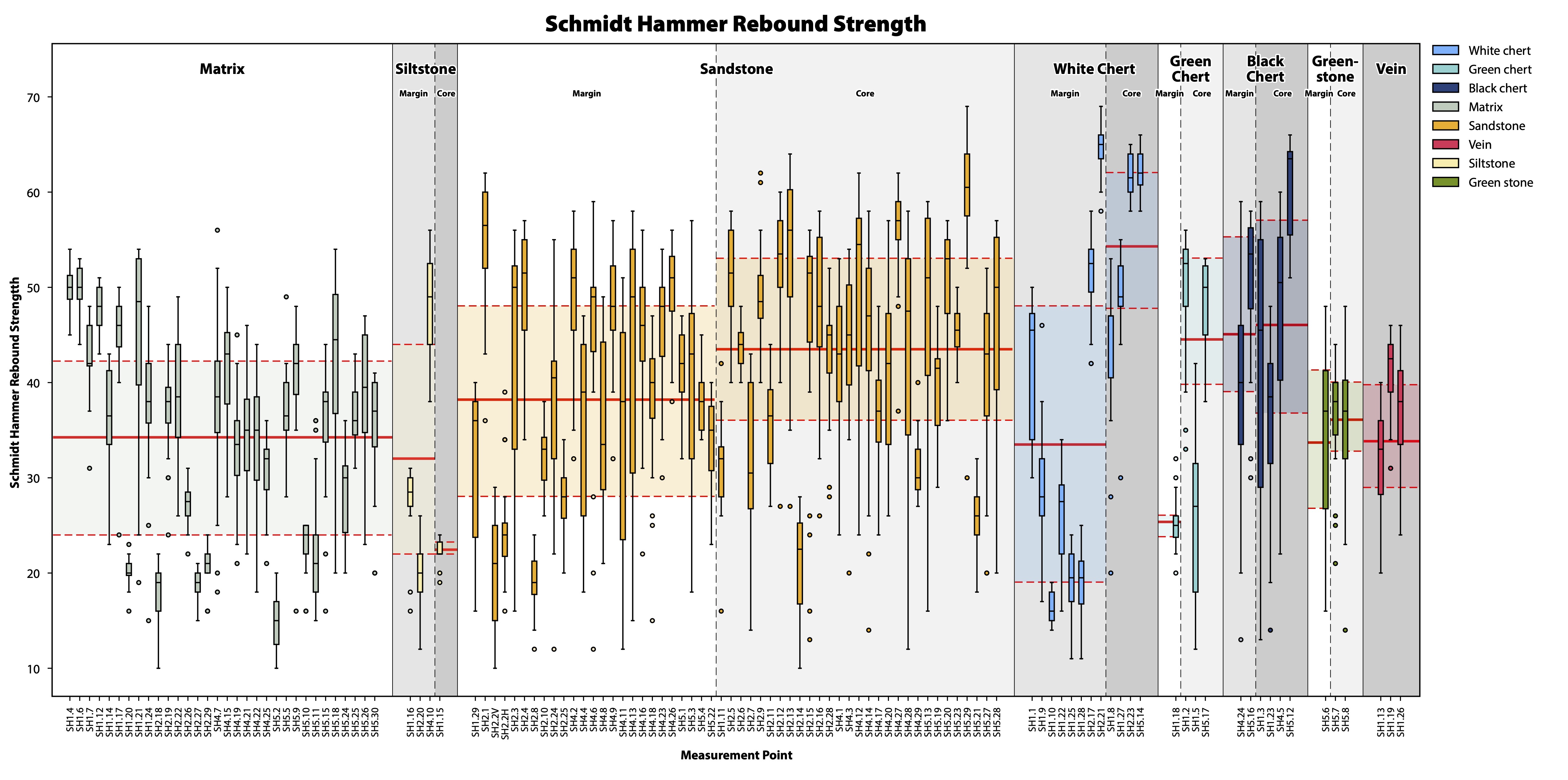
Mélange Heterogeneity Revealed by Schmidt Hammer Strength Tests
In-situ strength tests of blocks and matrix in the Chrystalls Beach Mélange, New Zealand showing systematic differences between the strengths of block cores and margins.
Publications
Clarke, A.P., Haas, R., Hawemann, F., Toy, V.G.
Systematic Evaluation of the Influence of Camera Placement and Settings on the Quality of Photogrammetric Models of Rocks
Vannucchi, P., Clarke, A.P., de Montserrat, A., Ougier-Simonin, A., Aldega, L., Morgan, J.P.
A strength inversion origin for non-volcanic tremor
Clarke, A.P., Vannucchi, P.
Structural anisotropy: Using image analysis to quantify block-in-matrix fabrics
Clarke, A.P.
Heterogeneous input in a subduction system & its effect on plate boundary processes: Structural analysis of the Osa Mélange, SW Costa Rica
Clarke, A.P., Vannucchi, P., Morgan, J.P.